


GMAT prep tips: Quantitative section
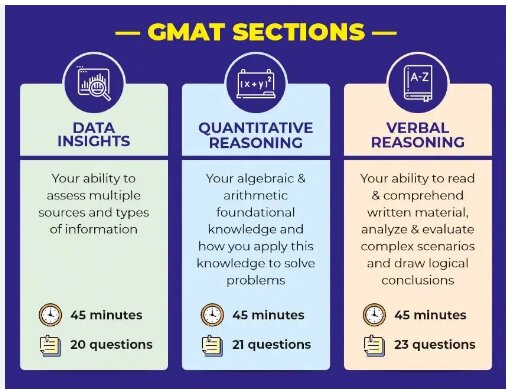
The Quantitative section of the GMAT Test measures basic mathematical skills. It tests a candidate’s understanding of elementary concepts in mathematics learned at school and the ability to reason quantitatively. The section involves solving quantitative problems, reasoning using quantitative techniques, and interpreting graphic data.
The Quantitative section measures a candidate’s ability to analyze the data and draw conclusions using reasoning skills. Although one needs to have good mathematical skills to solve the questions in the Quants section, however, the mathematics that one needs is taught in secondary school. In this article, we have given GMAT Quantitative tips, so, you can prepare better for the quants section.
Test Section Duration: 75 minutes
Format: 37 questions
Tests: Problem Solving and Data Sufficiency
The Quantitative section consists of two question types.
- Problem Solving Problem solving questions are standard 5-choice multiple-choice questions.
- Data sufficiency questions consist of a question followed by two statements.
Your job is to decide whether the information in the statements is sufficient to answer the question. These questions require much less calculation than standard problem-solving.
Skills Measured in the GMAT Quantitative Section
-
Ability to reason quantitatively, solve quantitative problems, and interpret graphic data
-
Understanding problems involving arithmetic, elementary algebra, and common geometry concepts
-
Evaluation of the amount of information needed to solve quantitative problems
-
Analyzing a quantitative problem
-
Recognizing which information is relevant
-
To be able to determine at what point there is sufficient information to solve a problem
Tips for Problem Solving Questions
Problem-solving questions test your ability to use logical and analytical reasoning to solve quantitative problems. Candidates need to solve the problem and mark the answer from the given choices.
- Increase speed: Keep on checking the screen-timer during the test. Do not waste too much time on a problem you are not able to solve and move to the next question. Try to finish the complete section.
- Read every question carefully: Read every question carefully to understand the given data and what is being asked. read every sentence carefully and translate the data into equations to solve the problem.
- Use the erasable board: Use the erasable noteboard given at the test center. Solving the questions in writing may help you in getting the right answers and avoid mistakes.
- Take a glance at the answer choices: Before giving the answer go through the options given for the answer. Else, you may spend time on getting an answer that is not given in the choices.
- Do not focus on one question for too long: If a question is taking too much time then move to the next one. Check out the choices and eliminate the ones you think are wrong and select the best option and move to the next question.
Tips for Data Sufficiency Questions
Data Sufficiency tests your ability to analyze a quantitative problem, recognize which data is relevant, and also determine at what point is there enough data to solve the given problem.
- Check whether the problem allows a range of values or only one value: You only have to determine whether you have enough data or not.
- Avoid unwarranted assumptions based on geometric figures: It is not necessary that figures be drawn to scale.
Math Skills Required to solve GMAT Quant Section
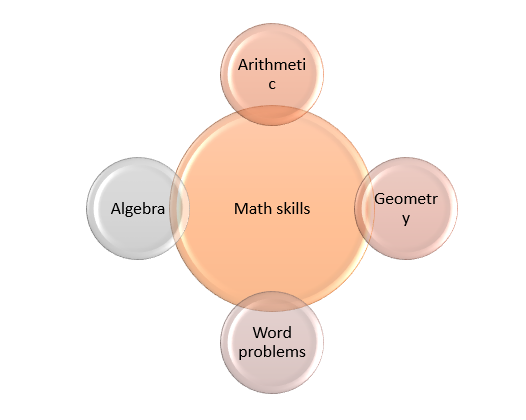
One needs to have basic mathematical skills to solve the Quantitative Reasoning Section of the GMAT exam. Some of the areas where you need to focus and increase your Maths knowledge are
- Arithmetic – basic arithmetic including fractions, statistics, integers, and probability, and powers and roots
- Algebra – how to solve different types of equations and topics like variables and functions
- Geometry – properties of geometric objects, including triangles, circles, quadrilaterals, solids, and cylinders
- Word problems – geometric principles to solve problems, blending arithmetic, and algebraic

You May also like:
- IELTS Registration (How to Book a Test)
- IELTS Exam Dates FAQ
- How to Choose IELTS Test Dates
- How to Send IELTS Scores to Colleges
GMAT quantitative section tricks
-
Know math formulas before you take the GMAT.
-
Take advantage of your scrap paper. Use it to draw pictures, work out formulas, and cross out wrong answer choices.
-
Since you will not need the keyboard for the Quantitative section, move it aside to give you more desk room for writing on your scrap paper.
-
Advanced topics such as trigonometry and calculus are not tested on the GMAT. To score well, you only need to be familiar with school-level arithmetic, geometry, and algebra.
-
Do not rely on your visual judgment to answer geometry questions. One common mistake is to assume that 2 lines must form a right angle, when this is not stated anywhere in the text.
-
Spend at least 30 seconds reviewing the diagrams. Many facts can be drawn from the illustrations.
-
Similarly, spend 30 seconds reviewing the graphs and tables. Graph problems are supposed to test your ability to interpret and use graphs and tables and don’t require hard calculations.
-
However, you can rely on visual estimates for bar graphs and line charts. The test writers will not use visual tricks on these questions.
-
Learn how to work backwards. If you are completely stuck on a question, you can select an answer choice and work backwards to see if it makes sense.
-
Don’t rush through the easy questions and make careless mistakes.
- Eliminate answer choices that don’t make sense.
Related Posts:
- Busting Myths About Studying Abroad
- TOEFL Exam 2026
- 25 Scholarships in USA
- Top 10 Scholarships in Italy for International Students
- Top 10 Prestigious Scholarships for the Best Students
- 35+ International Scholarships for Development-Related Studies
- 15+ Tuition Fee Scholarships offered by Universities for International Students
- 10 Distance Learning Scholarships & Tuition
- Top 10 International Scholarships for Women
- 10+ Scholarships in Australia for International Students
- Top 50 International Scholarship Programs Offered Annually
- Top 10 Science, Engineering, Technology Scholarships for Foreign Students
- Top 15 Bachelor’s Degree Scholarships for International Students
- Top 10 International Scholarships for African Students
- PTE Academic 2026
- GRE Exam 2026
- GMAT 2026 Exam
Mastering GMAT Focus Edition Quantitative Reasoning: Comprehensive Prep Tips, Strategies, and Practice Habits
For aspiring business school students worldwide, the Graduate Management Admission Test (GMAT) is a critical milestone. With the transition to the GMAT Focus Edition, the exam has evolved to become more streamlined and highly focused on the exact skills modern business leaders need.
Nowhere is this shift more apparent than in the Quantitative Reasoning (Quant) section. Gone are the days of memorizing obscure geometry formulas. Today’s GMAT Quant section is a pure test of your analytical mindset, logical reasoning, and data-driven problem-solving capabilities.
If you want to achieve a competitive score for top-tier MBA programs, you need a structured, strategic approach. This comprehensive guide breaks down everything you need to know to master GMAT Quantitative Reasoning, from understanding the core structure to high-level tactical strategies.
Understanding the GMAT Focus Edition Quant Section
Before diving into study habits, it is vital to know exactly what you are up against. The GMAT Focus Edition has redesigned the Quant experience to test higher-order reasoning rather than rote memorization.
Key Structure & Timing
-
Number of Questions: 21 questions
-
Time Allotted: 45 minutes
-
Average Time per Question: Approximately 2 minutes and 8 seconds
-
Scoring Range: 60 to 90
The Big Shift: Problem Solving Only
Unlike the legacy GMAT, which included Data Sufficiency questions within the Quant section, the Focus Edition features only Problem Solving questions in Quantitative Reasoning. (Data Sufficiency has been moved entirely to the Data Insights section).
Major Content Shift: No Geometry
Perhaps the most celebrated change in the Focus Edition is the complete removal of geometry (except for coordinate geometry, which can occasionally overlap with algebra). The exam now heavily isolates arithmetic and algebra, testing how deeply you understand properties of numbers, rates, percentages, and algebraic functions.
Core Topics Tested in GMAT Quant
To prepare effectively, you must align your study schedule with the exact mathematical domains tested on the exam.
1. Arithmetic (Number Properties & Operations)
Arithmetic on the GMAT isn’t just basic addition and subtraction; it tests your conceptual understanding of how numbers behave. Expect questions covering:
-
Properties of Integers: Divisibility, factors, multiples, prime factorization, remainders, and even/odd integer rules.
-
Fractions, Decimals, and Percentages: Ratios, proportions, percentage increases/decreases, and compounding concepts.
-
Exponents and Roots: Manipulating bases, fractional exponents, and simplifying radical expressions.
-
Descriptive Statistics: Mean, median, mode, range, and standard deviation conceptual questions.
2. Algebra (Equations & Functions)
Algebra questions test your ability to translate word problems into mathematical expressions and solve them efficiently. Core topics include:
-
Linear & Quadratic Equations: Solving simultaneous equations, factoring quadratics, and understanding roots.
-
Inequalities: Absolute value inequalities and system of inequalities.
-
Functions & Sequences: Evaluating functions, understanding domain/range, and identifying patterns in arithmetic or geometric sequences.
-
Word Problems: Rates (speed/distance/time), work problems (simultaneous work rates), and mixture problems.
Top Prep Tips for GMAT Quantitative Reasoning
Achieving a high score in 45 minutes requires a blend of conceptual clarity and tactical speed. Use these proven tips to optimize your prep.
1. Master the Foundations First
Do not jump straight into solving high-level GMAT questions if your math fundamentals are rusty. Spend the first few weeks of your preparation reviewing basic algebraic manipulations, fraction operations, and number property rules. If you cannot confidently find the prime factorization of a three-digit number or isolate a variable in a complex fractional equation within seconds, you will struggle with timing later on.
2. Treat Quant as a Logic Test, Not a Math Test
The GMAT is an exam for future managers, not mathematicians. The questions are intentionally structured to trick individuals who rely solely on brute-force calculation. Always ask yourself: “Is there a shortcut here?” Look for patterns, estimate whenever possible, and leverage properties (such as checking units digits or using even/odd logic) to eliminate answer choices without performing heavy arithmetic.
3. Use Strategic Tactics: Plugging In and Backsolving
When abstract algebra threatens to slow you down, pivot to concrete numbers.
-
Plugging In: If a problem features variables in both the question stem and the answer choices, substitute easy-to-use numbers (like 2, 3, or 100) for the variables to find the matching answer.
-
Backsolving: If the question asks for a specific value and the answer choices are listed in ascending or descending order, plug the answer choices back into the problem. Start with choice C; if it’s too small, move to a larger number, effectively eliminating multiple options at once.
4. Build a Deep Error Log
The secret to scoring a 90 on GMAT Quant isn’t doing 5,000 practice questions; it’s deeply analyzing the 500 questions you got wrong or found difficult. Maintain a meticulous error log (using Excel or a notebook) that tracks:
-
The exact question and topic.
-
Why you got it wrong (e.g., conceptual gap, careless calculation, time pressure).
-
The key takeaway or shortcut you missed.
-
A re-test date to try the question again fresh.
5. Learn to Let Go (Time Management)
Because the GMAT Focus Edition is computer-adaptive, the test adapts to your performance. You will encounter questions that feel incredibly difficult. Spending 4 or 5 minutes trying to crack a single problem will ruin your pacing for the rest of the section. If you are completely stuck after 1.5 minutes, make an educated guess, eliminate obviously wrong answers, and move on.
Note: The GMAT Focus Edition allows you to bookmark questions and change up to three answers per section at the end if time permits. However, you shouldn’t rely on this; manage your time effectively on the first pass.
Developing a Structured GMAT Quant Study Plan
Success on the GMAT requires consistent, disciplined study habits. Here is how you can phase out your preparation over a typical 2-to-3-month window:
[Phase 1: Diagnostic & Foundation]
       │
       ▼
[Phase 2: Topic-Specific Mastery]
       │
       ▼
[Phase 3: Mixed Practice & Pacing]
       │
       ▼
[Phase 4: Full-Length Mocks & Review]
Phase 1: Diagnostic & Foundation (Week 1–2)
Take an official GMAT Focus diagnostic practice exam to establish your baseline score. Identify your weak areas right out of the gate. Dedicate this phase to reviewing basic math concepts without worrying about the timer.
Phase 2: Topic-Specific Mastery (Week 3–6)
Group your study sessions by topic. Spend a few days focusing exclusively on Properties of Integers, followed by a few days on Linear Equations, and so on. For comprehensive study timelines and resources tailored to standardized examinations, checking structured study guides on Student Arrive can help keep your weekly calendar organized.
Phase 3: Mixed Practice & Pacing (Week 7–9)
Once you understand individual topics, start mixing them up. Your brain needs to practice identifying what a question is asking without the context clue of a chapter title. Start introducing strict 2-minute-per-question timing during these mixed sets.
Phase 4: Full-Length Mocks & Refinement (Week 10+)
Take official practice exams weekly under real testing conditions. Practice your pacing strategy, manage exam anxiety, and use your error log to fix final conceptual gaps before test day.
Vital Test-Day Reminders
-
No Calculator Allowed: The Data Insights section provides an on-screen calculator, but the Quantitative Reasoning section does not. You must rely on mental math and scratch paper work. Keep your scratchpad organized to avoid simple calculation errors.
-
Read the Question Twice: The GMAT is famous for “hidden traps.” It might ask for the value of $x + y$ instead of just $x$, or it might specify that $x$ must be a positive integer. Read carefully so you don’t solve for the wrong value.
-
Don’t Panicked by Hard Questions: If the questions are getting progressively harder and more complex, it usually means you are doing well! Maintain your composure and stick to your strategies.
Conclusion
Mastering the GMAT Focus Edition Quantitative Reasoning section requires moving past basic math memorization and developing agile, logical thinking patterns. By mastering arithmetic and algebraic foundations, maintaining a strict error log, utilizing tactics like backsolving, and managing your pacing, you can walk into the testing center with complete confidence.
For more actionable exam preparation roadmaps, past material insights, and academic success strategies, visit Student Arrive to supercharge your study journey today.