


GMAT prep tips: Verbal section
The verbal section of the GMAT exam measures the test taker’s ability to read and comprehend the written material, reason and evaluate arguments, and correct written material to express ideas effectively in standard written English. The GMAT Verbal section is difficult to crack. Very few test-takers get a perfect score of 51. In this article, we will give you tips and strategies to handle the GMAT Verbal questions accurately.
Time: 65 minutes
Format: 36 questions
Tests: Reading Comprehension, Critical Reasoning, Sentence Correction
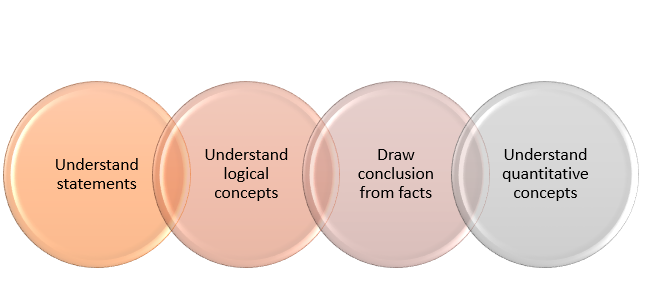
Skills Measured
-
Understanding statements
-
Understanding the logical concepts in the reading passages
-
Drawing conclusion from facts and statements
-
Understanding the development of quantitative concepts as they are presented in verbal material

You May also like:
- IELTS Registration (How to Book a Test)
- IELTS Exam Dates FAQ
- How to Choose IELTS Test Dates
- How to Send IELTS Scores to Colleges
Reading Comprehension Questions
Reading Comprehension passages are up to 350 words long. Because the Reading Comprehension section includes passages from several different content areas, the student may be generally familiar with some of the material.
Critical Reasoning Questions
Critical Reasoning questions are designed to test the reasoning skills involved in making arguments, evaluating arguments, and formulating or evaluating a plan of action.
Sentence Correction Questions
Sentence Correction questions ask you which of the five choices best expresses an idea or relationship. The questions will require you to be familiar with the stylistic and grammatical rules of standard English.
GMAT Verbal Section Tips
Below provided the tips for GMAT Verbal Section. These tricks will help you in GMAT Verbal preparation.
Tips for Reading Comprehension
There are 3 common types of topics for comprehension passages. The way you go about answering the question will be slightly different for each.
-
Passages dealing with the sciences, such as biology and chemistry are factual and straightforward.
-
Passages dealing with the social sciences, such as history and geography will present many conclusive questions, so you have to read them slowly.
-
Passages dealing with business-related areas are tough, as they have difficult structures, and may even ask you to determine the author’s mood and opinions
-
When answering a factual question, keep in mind that they are the most straightforward kind of question.
-
When you are asked to describe the tone of the passage, the tone is more likely to be positive or neutral than negative. In a science passage, it is likely to be neutral.
-
As you read, focus on the main theme, the author’s tone, and paragraph topics rather than the specific details of the passage.
-
Read the first question before you read the passage. You will have a better idea of what to focus on.
-
When answering a fact question, carefully read both the passage providing the data – and several lines before it.
Tips for Critical Reasoning
-
Read the question first so you know what kind of question you have to answer before you read the argument.
-
For ‘strengthen’ or ‘weaken-the-argument’ questions, determine what type of reasoning the author uses and choose an answer that either helps or hurts that way of reasoning.
-
For questions that ask you to draw conclusions, choose an answer that contains the basic idea of the author.
-
The answer must be a logical extension of the argument in the passage. Never choose an answer simply because you feel it is true.
-
Try to guess the correct answer before you read the answer choices. This will help you focus on the best answer.
-
Read all the answer choices. Eliminate the ones you know are wrong, and analyze the remaining ones with a focus on identifying the one that presents the most correct answer.
Tips for Sentence Correction
The correct answer will have these 4 characteristics:
-
No grammar errors
-
Correct sentence structure
-
No diction errors
-
No changes to the sentence’s intended meaning
-
Look out for multiple errors. A common mistake is to find one error in the sentence, without noticing that there are other errors in the sentence.
-
Compare the answer choices. Seeing how the choices differ from one another is a good way to find out what errors might be in the underlined text.
-
Say the choices in your head and see whether they sound right.
- You may also like;
IELTS Indicator: All you need to know
IELTS Academic vs General Tests
IELTS or TOEFL- Which one is better For USA
Mastering the GMAT Verbal Reasoning Section: Sample Questions, Answers, and Strategies
If you are planning to pursue an MBA or a business master’s degree, cracking the Graduate Management Admission Test (GMAT) is likely high on your priority list. While many business-minded candidates focus heavily on data analysis and calculations, the GMAT Verbal Reasoning section often proves to be the true differentiator between a good score and an elite score.
On the current GMAT Focus Edition, the Verbal Reasoning section challenges your ability to read critically, evaluate arguments, and synthesize complex text. Unlike older versions of the test, Sentence Correction has been removed, meaning your absolute focus must now be on two core areas: Reading Comprehension (RC) and Critical Reasoning (CR).
Understanding the GMAT Verbal Layout
The GMAT Focus Edition Verbal section consists of 23 questions that you must answer in 45 minutes. This gives you an average of just under 2 minutes per question.
-
Reading Comprehension (~13-14 questions): Evaluating long or short passages on topics ranging from social sciences and business to physical or biological sciences.
-
Critical Reasoning (~9-10 questions): Analyzing short arguments (usually a single paragraph) to find assumptions, strengthen or weaken premises, or draw logical conclusions.
Achieving a high score requires structured practice and a deep understanding of standard question patterns. For a smooth study experience, setting up a routine with clear milestones is invaluable; you can map this out with a guide on creating an effective spaced repetition study schedule to maximize your retention.
1. Critical Reasoning (CR) Core Concepts
Critical Reasoning questions assess your logic. Every argument is composed of premises (facts) and a conclusion (the claim). The gap between the premise and conclusion is the assumption. Your job is to identify, exploit, or defend this unstated assumption.
Practice Question 1: Weaken the Argument
Passage:
A tech startup recently introduced a mandatory mindfulness and meditation program for its software engineering team, aiming to reduce burnout and boost coding productivity. After three months, the management reported that the overall number of coding bugs dropped by 15 percent. Management concluded that the meditation program was highly effective at improving the engineers’ focus and attention to detail.
Question: Which of the following, if true, most seriously weakens management’s conclusion?
-
A) The engineering team worked an average of 5 hours of overtime per week over the last three months.
-
B) Concurrently with the meditation program, the company implemented a rigorous new automated code-testing suite that flags syntax bugs before they are counted.
-
C) Surveys show that 30 percent of the engineers initially resisted participating in the mandatory meditation sessions.
-
D) Other startups in the same tech incubator reported an increase in software bugs during the same three-month window.
-
E) The cost of hiring mindfulness coaches was slightly higher than the management had budgeted.
Correct Answer & Explanation
Correct Answer: B
-
Why it’s right: The argument attributes the 15 percent drop in coding bugs entirely to the mindfulness sessions (a classic correlation vs. causation flaw). Option B introduces an alternative cause—the new automated code-testing suite. If a tool is automatically filtering out bugs before they are recorded, the drop in bugs cannot be cleanly attributed to human mindfulness.
-
Why others fail: A is neutral or could imply they worked harder. C notes resistance but doesn’t change the actual outcome. D strengthens rather than weakens by showing the company performed better than its peers. E mentions cost, which is irrelevant to the effectiveness of the program itself.
2. Reading Comprehension (RC) Core Concepts
GMAT Reading Comprehension passages are dense and purposefully filled with complex academic jargon. Successful test-takers do not try to memorize every detail on the first read. Instead, they read for structure, tone, and main idea.
Practice Passage
Historically, biometric authentication systems have relied primarily on static traits, such as fingerprints or iris scans, to verify identity. While highly accurate under controlled conditions, these systems are vulnerable to sophisticated spoofing techniques, including high-resolution skeletal replicas or synthetic overlays. To mitigate these vulnerabilities, security engineers are increasingly pivoting toward behavioral biometrics, which analyze continuous human actions like keystroke dynamics, gait, or vascular pulse modulations.
Because behavioral traits are deeply tied to neurological and musculoskeletal habits, they are exceptionally difficult to replicate artificially. However, behavioral biometrics introduce a distinct operational trade-off: high intra-individual variability. A user’s typing rhythm or gait can fluctuate dramatically based on physical fatigue, ambient temperature, or emotional stress, leading to elevated False Rejection Rates (FRR) that can frustrate users and compromise system efficiency.
Practice Question 2: Primary Purpose
Question: The primary purpose of the passage is to:
-
A) Advocate for the complete replacement of static biometric verification systems with behavioral metrics.
-
B) Describe how spoofing techniques have rendered traditional security protocols entirely obsolete.
-
C) Introduce an emerging alternative to traditional biometric systems and discuss its inherent limitations.
-
D) Detail the specific neurological mechanisms that govern human keystroke dynamics and gait.
-
E) Argue that False Rejection Rates can be eliminated by modifying environmental variables like temperature.
Correct Answer & Explanation
Correct Answer: C
-
Why it’s right: The passage introduces behavioral biometrics as an alternative to vulnerable static traits (Paragraph 1) and balanced this in Paragraph 2 by pointing out its primary flaw: high intra-individual variability causing elevated False Rejection Rates. This perfectly matches the description of introducing a trend while addressing its limitations.
-
Why others fail: A uses extreme language (complete replacement). B exaggerates by stating traditional protocols are entirely obsolete. D is too narrow—neurology is only mentioned in passing. E is incorrect because the passage implies these variations are difficult to eliminate.
High-Scoring Strategies for GMAT Verbal Success
To scale your score into the 80th percentile or above, avoid standard traps by employing a systematic approach:
-
Pre-think the Answer in CR: Do not look at the choices immediately after reading a Critical Reasoning prompt. Spend 15 seconds formulating your own answer to what the assumption, weak point, or strong point is. Matching your thought to an option is much safer than letting the options trick your logic.
-
Track the Author’s Voice: In Reading Comprehension, distinguish between what external experts believe versus what the author believes. Look for transition words like however, conversely, furthermore, and unexpectedly.
-
Use the Process of Elimination (POE): GMAT Verbal questions are often easier to solve by finding four wrong answers than trying to identify the perfect right one. Look out for “too broad,” “too extreme,” or “out of scope” answer choices.
If your long-term goal involves pairing your GMAT score with global academic scholarships to fund your MBA, you need to ensure every component of your profile stands out. Dive into this strategy guide on how to write winning scholarship essays to learn how to present your professional goals with absolute clarity.
Key Takeaway: GMAT Verbal is an open-book exam; the answers are always right there on the screen. Success depends entirely on your mental stamina and how strictly you apply logical constraints to avoid picking choices that sound plausible but are unbacked by the provided text.
- Top 10 International Scholarships for Women
- 10+ Scholarships in Australia for International Students
- Top 50 International Scholarship Programs Offered Annually
- Top 10 Science, Engineering, Technology Scholarships for Foreign Students
- Top 15 Bachelor’s Degree Scholarships for International Students
- Top 10 International Scholarships for African Students
- PTE Academic 2026
- GRE Exam 2026
- GMAT 2026 Exam