


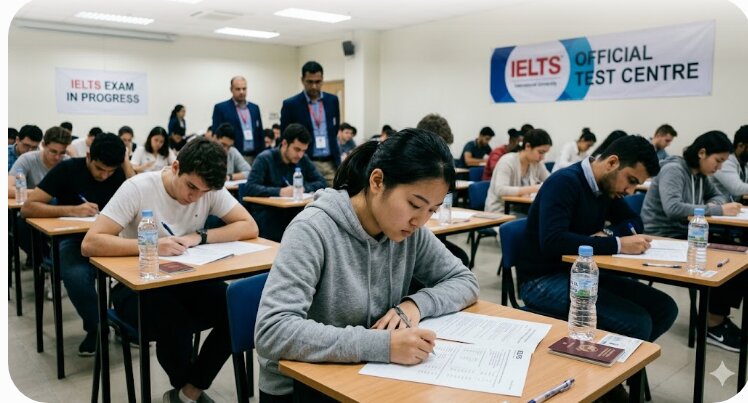
Take the IELTS test in or nearby Ghana; www.ielts.org
There are 5 centers offering IELTS tests (paper-based or computer-delivered) in Ghana, please choose an appropriate test center that is closer to you or is most suitable for your test depending upon location or availability of test.
Make sure to prepare for the IELTS exam using our Free IELTS practice tests.
Kumasi, Ghana
British Council Kumasi – British Council, Kumasi
Address
British Council, Kumasi, Bank RoadKumasi, Ghana
British Council Kumasi – New Mission Academy
Address
New Mission Academy, Agric , Kwadaso,Plot No. 6 & 7, Agric KokodeAccra, Ghana
British Council Accra Office
Address
Accra Digital Centre, Ring Road WestAccra, Ghana
British Council Accra – British Council Accra
Address
British Council Accra, Accra,11 liberia Road, AccraTamale, Ghana
Take IELTS Test In or Nearby: Your Ultimate Guide
The IELTS (International English Language Testing System) test is a crucial step for students and professionals aiming to study, work, or migrate to English-speaking countries. Taking the IELTS test in or nearby your location offers convenience and accessibility, making the entire process smoother. This article provides a comprehensive guide on where and how to take the IELTS test in or near your area, along with useful tips and resources.
Why Take the IELTS Test?
IELTS is recognized globally by thousands of institutions, employers, and immigration authorities. It assesses your English language proficiency across four skills: Listening, Reading, Writing, and Speaking. Whether your goal is to pursue higher education, secure a job abroad, or fulfill immigration requirements, a good IELTS score is often mandatory.
For more information about the importance of IELTS, check out this Why Take the IELTS Test? article.
Finding IELTS Test Centres Near You
Taking the IELTS test close to your home is important to reduce travel stress and manage expenses. In Nigeria and other nearby regions, there are several authorized IELTS test centres. Studentarrive.com.ng provides updated details on these centres, including locations, registration processes, and exam dates.
Explore the list of IELTS Test Centres in Nigeria to find the nearest centre to you.
How to Register for the IELTS Test
Registering for the IELTS test is straightforward but requires attention to deadlines and required documents. You can register online or directly at the test centre, depending on the centre’s guidelines.
For step-by-step instructions on registration, visit How to Register for the IELTS Test.
Preparing for the IELTS Test
Preparation is key to achieving your desired band score. Many candidates enroll in preparation courses or use self-study materials. Studentarrive.com.ng offers resources and advice on how to prepare effectively for each section of the IELTS exam.
Read the comprehensive guide on IELTS Preparation Tips to boost your confidence and performance.
IELTS Test Costs and Payment Methods
Understanding the test fees and payment methods beforehand helps avoid any last-minute issues. Fees may vary slightly depending on the test centre.
For detailed information on costs, see IELTS Test Fees in Nigeria.
What to Expect on Test Day
Knowing what happens on test day can help reduce anxiety. You will take tests in Listening, Reading, and Writing on the same day, while Speaking might be scheduled on the same or a different day.
Learn more about IELTS Test Day Procedures to be fully prepared.
IELTS Results and Score Reporting
Your IELTS results are typically available within 13 days after the test date. You will receive a Test Report Form (TRF), which you can use to apply to universities or employers.
For details on results and how to send them to institutions, visit IELTS Results and Score Reporting.
Frequently Asked Questions About IELTS
Still have questions? Studentarrive.com.ng has a helpful FAQ section answering common queries about the test format, scoring, retakes, and more.
Check out the IELTS FAQ for quick answers.
Taking the IELTS test nearby not only saves time and money but also allows you to focus better on your exam without travel-related stress. By using the resources and information available on Studentarrive.com.ng, you can confidently plan your test, prepare well, and achieve the score you need for your future goals.
If you want to explore other related exams or study opportunities, visit the Exams and Tests section on Studentarrive.com.ng.
Good luck with your IELTS journey!
British Council Accra – Radach
Address
Radach, Tamale,#73 Industrial Area, Lamashegu TamaleAlso check
- IELTS Indicator: All you need to know
- IELTS Exam Result 2026
- IELTS Results and Scores FAQs
- IELTS Academic vs General Tests
Ultimate IELTS Vocabulary Exercises with Answers: Master the Words to Boost Your Band Score
One of the most critical factors in achieving a high band score in the International English Language Testing System (IELTS) is your vocabulary. In both the Writing and Speaking modules, Lexical Resource accounts for exactly 25% of your total marks. Furthermore, having a robust vocabulary is the key to decoding complex texts in the Reading section and catching fast-paced synonyms in the Listening section.
But simply memorizing long lists of words isn’t enough. To truly own a word, you must practice using it in context.
This comprehensive guide provides targeted IELTS vocabulary exercises complete with answers and explanations. By practicing these exercises, you will learn how to replace basic words with academic alternatives, use collocations naturally, and avoid common errors.
For more updates on tertiary examinations, international study pathways, and school guides, keep an eye on Student Arrive.
1. Academic vs. General Vocabulary Exercise
In the IELTS Academic module (and formal sections of the General Training module), using precise, formal language instead of conversational words can significantly elevate your score.
Exercise:
Replace the underlined informal or basic words in the sentences below with the most appropriate academic synonym from the box.
Word Box: prohibitively, exacerbate, plummet, utilize, detrimental, implement, advocate, indispensable
-
The government needs to put in place stricter laws to reduce environmental pollution.
-
High tuition fees make higher education too expensive for students from low-income families.
-
Fast food has a bad effect on a person’s long-term physical health.
-
If we do not address traffic congestion now, it will make worse the city’s air pollution problems.
-
Many educational experts support the integration of artificial intelligence in modern classrooms.
-
Smartphone technology has become completely necessary for remote learning.
-
Statistics show that the crime rate began to drop quickly after the new community policing strategy was introduced.
-
Students should learn how to use online databases effectively when conducting research.
Answers & Explanations:
-
implement (To put a plan, decision, or agreement into effect)
-
prohibitively (At a price that is so high it prevents people from buying or doing something)
-
detrimental (Tending to cause harm; a formal synonym for “bad” or “harmful”)
-
exacerbate (To make a problem, bad situation, or negative feeling worse)
-
advocate (To publicly recommend or support a particular cause or policy)
-
indispensable (Absolutely necessary or essential)
-
plummet (To fall or drop straight down at high speed; ideal for Academic Writing Task 1 charts)
-
utilize (To make practical and effective use of something)
2. Topic-Specific Vocabulary: Environment & Technology
The IELTS exam relies heavily on specific recurring themes. Two of the most common topics are The Environment and Technology.
Exercise:
Fill in the blanks in the short paragraphs below using the correct words from the provided options.
Paragraph A: Environment
Options: sustainable, biodiversity, renewable, emissions, depletion
Governments worldwide are under immense pressure to reduce carbon 1. ____________ to combat global warming. Relying on fossil fuels accelerates the 2. ____________ of natural resources and damages local ecosystems. To achieve a greener future, transitions must be made toward 3. ____________ energy sources such as solar and wind power. Implementing 4. ____________ agricultural practices will not only protect the soil but also preserve the planet’s rich 5. ____________.
Paragraph B: Technology
Options: obsolete, automation, innovation, ubiquitous, tech-savvy
In the modern era, smartphones and high-speed internet have become 6. ____________, transforming how we communicate. Rapid technological 7. ____________ has forced industries to adapt quickly. For instance, the rise of industrial 8. ____________ has streamlined manufacturing processes, though it threatens traditional manufacturing jobs. Workers who fail to become 9. ____________ may find their skills becoming 10. ____________ in a highly competitive job market.
Answers:
-
emissions (specifically greenhouse gases released into the atmosphere)
-
depletion (the reduction in the number or quantity of something)
-
renewable (not depleted when used)
-
sustainable (able to be maintained at a certain rate or level without harming the environment)
-
biodiversity (the variety of plant and animal life in a particular habitat)
-
ubiquitous (present, appearing, or found everywhere)
-
innovation (the action or process of innovating; new methods or ideas)
-
automation (the use of largely automatic equipment in a system or manufacturing process)
-
tech-savvy (well-informed about or proficient in the use of modern technology)
-
obsolete (no longer produced or used; out of date)
3. IELTS Collocations Exercise
Collocations are words that naturally go together. Native English speakers use them subconsciously. Using accurate collocations (e.g., saying “make a decision” instead of “do a decision”) tells the examiner that your English command is natural and advanced.
Exercise:
Choose the correct verb or adjective to complete the collocation in each sentence.
-
The introduction of online voting could (exert / pose / create) a serious threat to cybersecurity.
-
Before choosing a university course, students must (take / draw / give) into consideration their long-term career prospects.
-
Rapid urbanization often (places / puts / gives) a heavy burden on municipal infrastructure and public utilities.
-
The researchers (made / conducted / drew) an extensive survey to gather data on remote working preferences.
-
Education plays a (pivotal / large / strong) role in breaking the cycle of poverty within developing nations.
-
To solve the issue of plastic pollution, citizens must (make / take / do) collective action.
Answers & Explanations:
-
pose (Collocation: to pose a threat / pose a risk)
-
take (Collocation: to take something into consideration / take into account)
-
places (Collocation: to place a burden on someone or something)
-
conducted (Collocation: to conduct a survey / conduct research / conduct an experiment)
-
pivotal (Collocation: a pivotal role—meaning a crucial or central role; far better than “big role”)
-
take (Collocation: to take action)
4. Advanced Synonyms for Writing Task 1 (Data Description)
If you are taking the Academic module, Writing Task 1 requires you to describe trends in graphs, charts, tables, or diagrams. Repeating the words “went up” or “went down” will limit your vocabulary score.
Exercise:
Match the basic description on the left with its advanced, band-boosting vocabulary equivalent on the right.
| Basic Trend Description | Advanced IELTS Vocabulary |
| 1. Stayed the same for a long time | A. Fluctuate wildly |
| 2. Reached the highest point | B. Hit a low point |
| 3. Went up and down erratically | C. Remain steady / Plateaued |
| 4. Reached the lowest point | D. Peak at / Reach a pinnacle |
| 5. Recovered after a fall | E. Drop marginally |
| 6. Decreased by a very small amount | F. Bounce back |
Answers:
-
1 — C: Stayed the same for a long time = Remain steady / Plateaued
-
2 — D: Reached the highest point = Peak at / Reach a pinnacle
-
3 — A: Went up and down erratically = Fluctuate wildly
-
4 — B: Reached the lowest point = Hit a low point
-
5 — F: Recovered after a fall = Bounce back
-
6 — E: Decreased by a very small amount = Drop marginally
Pro-Tips for Expanding Your IELTS Vocabulary
To maximize the benefits of these exercises, implement these study habits into your daily revision routine:
-
Don’t Just Learn Words, Learn Collocations: When you look up a new word like mitigate, don’t just learn that it means “to reduce.” Learn how it’s used: to mitigate risks, to mitigate the effects of climate change.
-
Keep a Vocabulary Journal: Divide your notebook by topics (Education, Health, Crime, Environment, Work). Whenever you read an article or complete a practice test, write down useful phrases under the corresponding topic.
-
Practice Active Recall: Try to construct your own IELTS-style essay sentences using at least three new words every day.
If you are preparing for international opportunities, ensuring your academic records and exam preparations are in order is crucial. Bookmark Student Arrive for up-to-date resources on university admissions, secondary and tertiary exams, and study guides tailored to help you succeed.