

The International English Language Testing System (IELTS) is a critical exam for many aspiring students, professionals, and migrants aiming to prove their English proficiency. Achieving a high score on the IELTS can open doors to prestigious universities, global career opportunities, and immigration pathways. However, succeeding on the IELTS requires more than just good English skills—it demands strategic preparation and exam techniques.
This comprehensive guide provides valuable tips and strategies to help you excel in each section of the IELTS exam and achieve your desired score.
Understanding the IELTS Exam
IELTS assesses four key English language skills:
- Listening
- Reading
- Writing
- Speaking
Candidates receive a band score from 0 to 9 for each skill, with an overall band score averaging the four.
There are two main IELTS versions:
- Academic: For higher education and professional registration.
- General Training: For work, immigration, and non-academic training.
General Tips for Success
1. Know the Test Format Thoroughly
- Familiarize yourself with the structure, timing, and types of questions in each section.
- Understanding the test format reduces anxiety and helps manage time efficiently.
2. Practice Regularly Under Exam Conditions
- Simulate real test environments with timed practice tests.
- This builds stamina and sharpens your ability to perform under pressure.
- IELTS Test Centres
- IELTS Slot Booking
- IELTS Exam Pattern
- IELTS Exam Pattern FAQs
- IELTS Syllabus
- IELTS Preparation Tips
3. Build Core English Skills Consistently
- Improve your vocabulary, grammar, reading speed, listening comprehension, and speaking fluency.
- Engage in daily English practice through reading, listening to podcasts, writing essays, and speaking with others.
4. Use Official IELTS Practice Materials
- Use materials from British Council, IDP, and Cambridge to get the closest experience to the actual exam.
- Practice sample questions and previous test papers.
5. Take Care of Your Physical and Mental Well-being
- Ensure adequate sleep, hydration, and nutrition before the test day.
- Manage stress through relaxation techniques and positive mindset.
Tips for Each IELTS Section
Listening Section
- Listen Carefully: Pay close attention to instructions and the number of answers required.
- Predict Answers: Use context clues to anticipate possible answers.
- Focus on Keywords: Identify and underline keywords in questions to listen for specific information.
- Practice Different Accents: IELTS includes British, Australian, New Zealand, and North American accents.
- Don’t Panic if You Miss an Answer: Move on quickly and focus on the next question.
- Use the 10 Minutes at the End Wisely: Transfer your answers carefully to the answer sheet, checking spelling and grammar.
Reading Section
- Skim and Scan: Quickly skim the text for general understanding and scan for specific information.
- Manage Your Time: Spend about 20 minutes on each passage.
- Understand Question Types: Familiarize yourself with multiple-choice, matching headings, true/false/not given, and summary completion.
- Highlight Keywords: Use keywords to locate answers efficiently.
- Avoid Spending Too Much Time on One Question: If stuck, move on and return if time permits.
- Practice with Academic or General Training Texts: According to your test type.
Writing Section
- Understand Task Requirements: Task 1 and Task 2 have different expectations; don’t confuse their formats.
- Plan Before Writing: Spend 5-10 minutes organizing ideas and structuring your essay or report.
- Use Clear Paragraphing: Introduction, body paragraphs, and conclusion should be well-structured.
- Focus on Coherence and Cohesion: Use linking words and phrases to connect ideas smoothly.
- Vary Your Vocabulary and Sentence Structures: Avoid repetition and demonstrate lexical resource.
- Answer the Question Fully: Stay on topic and address all parts of the prompt.
- Practice Writing Under Timed Conditions: Develop speed without sacrificing quality.
- Review and Edit: Reserve a few minutes to check grammar, spelling, and punctuation.
Speaking Section
- Practice Speaking English Daily: Engage in conversations, join speaking clubs, or use language exchange platforms.
- Familiarize Yourself with the Test Format: The test has three parts—introduction, long turn, and discussion.
- Be Confident and Natural: Speak clearly, at a moderate pace, and avoid memorized answers.
- Extend Your Answers: Provide explanations, examples, and reasons to show fluency.
- Use a Range of Vocabulary and Grammar: Show your language variety without overcomplicating.
- Listen Carefully to the Examiner’s Questions: Respond to what is asked, not what you expect.
- Practice Speaking on Various Topics: Current affairs, hobbies, studies, culture, and personal experiences.
- Manage Nervousness: Practice deep breathing and positive visualization.
Additional Strategies to Maximize Your Score
Time Management
- Divide your time effectively for each section.
- Practice pacing to ensure you complete all questions.
Avoid Common Mistakes
- Misreading questions or instructions.
- Writing off-topic or incomplete answers.
- Poor spelling and grammar.
- Speaking too briefly or memorizing responses.
Take Mock Tests and Get Feedback
- Mock exams help simulate test conditions.
- Seek feedback from teachers or language experts to improve.
Learn from Your Mistakes
- Review practice test errors.
- Focus on weak points and target improvement.
Recommended Resources
- Official IELTS Websites: British Council, IDP, Cambridge English
- Practice Books: Cambridge IELTS series, Barron’s IELTS Superpack
- Online Platforms: IELTS Liz, IELTS Simon, Road to IELTS
- Apps: IELTS Prep, IELTS Practice Test, Magoosh IELTS Prep
Final Thoughts
Achieving a high score on the IELTS exam requires a combination of strong English language skills, thorough understanding of the test format, and strategic preparation. By following these tips and dedicating time to consistent practice, you can approach the exam with confidence and maximize your performance.
Remember, the key to success lies in preparation, practice, and perseverance. Start early, use quality resources, and maintain a positive mindset throughout your IELTS journey.
www.ielts.org
The International English Language Testing System, or IELTS, is a standardized test of English language proficiency for non-native English language speakers.
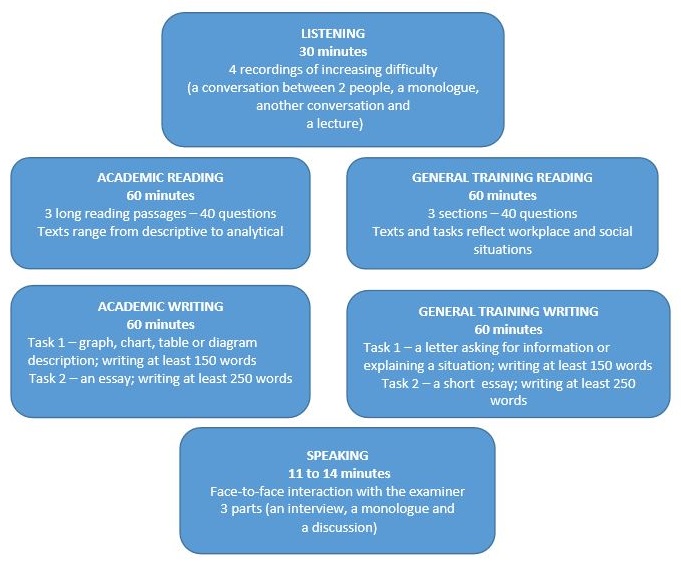
IELTS Exam Format
The IELTS Academic module tests the language skills of non-native English language speakers who want to study at a college or university in an English-speaking country where the medium of instruction is English. IELTS is recognized by most academic institutions and professional organizations in Europe, Australia, Canada, New Zealand and the United States.
The IELTS General Training module tests the language ability of non-native English language speakers who intend to go abroad, especially to English-speaking countries for vocational training programmes (not for degree), work or immigration. Employers, professional bodies and immigration departments in Australia, Canada, New Zealand, the UK, the USA and more than 140 other countriesrecognize IELTS exam as proof of English language proficiency level.
Both the modules consist of four parts: Listening, Reading, Writing and Speaking. Listening and Speaking are the same for both modules
Score / Grade Range
You can receive a score from 1 to 9 in each part of the test (Listening, Reading, Writing and Speaking). Your overall band score is equal to the average of the scores of the four parts. You can receive a whole (e.g. 6.0, 7.0, 8.0) or a half (e.g., 6.5, 7.5, 8.5) bands in each part of the test.
Tips to Achieve a High Score in IELTS
Listening
Before the IELTS Listening test:
- Listen to radio programmes, news, and lectures; watch films and online videos in English. Try to familiarize yourself with British English. You can take the help of British news channels such as BBC for this purpose.
- Familiarize yourself with each listening test question type such as multiple choice, matching and labelling.
During the IELTS Listening test:
- Listen to the audio instructions before each section carefully. These instructions are not printed in the test booklet.
- Read the instructions in the test booklet carefully for the number of words you need to write on the answer sheet. If you write more words than required, you will lose marks.
- Read the questions before listening. 30 to 60 seconds are given for reading the questions and instructions.
- Underline the key words in the question. However, listen to the synonyms and paraphrases too.
- Visualize the situation and try to predict the answer.
- Pay special attention to negatives (not, never, none, no one, barely, hardly, scarcely, etc.)
- Check your answers during the 30-second pause time after each section.
- During the 10-minute time, transfer the answers from the test booklet onto the answer sheet.
- Make sure you have transferred all answers onto the answer sheet. Do not leave empty spaces even if you don’t know the answer; make your best guess
- Make sure you have used correct grammatical form and correct spelling of the word(s) in your answer.
Reading
Before the IELTS Reading test:
- Read newspapers, magazines, journals, and books in English. While reading, underline or highlight less common words.
- Practice guessing the meaning of an unknown word from the context. If you still do not understand the meaning of the word, check it in a dictionary.
- Keep up with the news. The topics of the reading passages often deal with current affairs.
- Be familiar with each Academic or General Training reading test question type.
- Practise reading within a time frame. You need to be able to read fast in order to be able to read all three passages and answer 40 questions in 60 minutes.
- Practise reading techniques such as skimming, scanning and intensive reading.
During the IELTS Reading test:
- Read the instructions carefully during the test as they may slightly differ from the ones you got familiar with while practicing the test.
- Underline key information and/or make notes in the reading passages in the test booklet.
- Divide your time wisely: if you spend more than a minute answering a question and still do not have an answer, leave it and proceed to the next question. If you have some time left after you answer the rest of the questions, you may return to the question.
- Make sure you have transferred all answers onto the answer sheet. Do not leave empty spaces even if you don’t know the answer; take your best guess.
Writing
Before the IELTS Writing test:
- If you plan to take the IELTS Academic module, look for model graph/chart/diagram descriptions (model Writing Task 1 answers) online and analyse them in terms of organization of ideas and vocabulary.
- If you plan to take the IELTS General Training module, look for model letters (model Writing Task 1 answers) online and analyse them in terms of organization of ideas and vocabulary.
- Find model IELTS essays online and analyse them in terms of task response, essay structure, coherence, vocabulary, and sentence variety.
During the IELTS Writing test:
- Analyse each task carefully and underline the keywords.
- Do not use the task words in your writing; use your own words and sentence structures.
If you plan to take the IELTS Academic Module:
- Make sure you understand the ‘essay question’. Are you asked to give an opinion, to compare or contrast, to discuss causes and/or effects or to present solutions to problems?
- Make sure to answer what has been asked. Do not deviate from the topic.
- Try to limit your essay to 350 words. Your priority should be quality not quantity.
- Keep track of time. Leave about 3 minutes for revising Writing Task 1 and at least 5 minutes for revising your essay.
If you plan to take the IELTS General Training Module:
- Do not start writing your letter and your essay without planning them first.
- Write at least 150 words but try to limit your writing to 200 words in Writing Task 1.
- Keep track of time. Leave about 3 minutes for revising Writing Task 1 and at least 5 minutes for revising Writing Task 2.
- Write at least 250 words but try to limit your essay to 350 words in Writing Task 2.
Speaking
Before the IELTS Speaking test:
- Practise speaking as much as possible.
- Read books, watch movies and TV, listen to the radio, preferably in English. While reading, watching or listening, think why you like or dislike it.
- Speak in English with other students before entering the exam room. It will help you to switch to English more easily.
During the IELTS Speaking test:
- Keep calm. If you are relaxed, you will be able to give a better performance.
- Say as much as you can when speaking; give extended responses.
- Don’t think about grammar or vocabulary. Concentrate on answering the questions to the best of your ability.
- Correct yourself if you make a mistake.
- Ask the examiner to clarify or repeat the question if there is anything you do not understand.
- Pay attention to your body language; do not overuse gestures.
- Keep to the topic.
- As the exam is a formal situation, use neutral or semi-formal language.
Preparation for any exam is a continuous process that requires time and effort. Every practice test you do, every listening, reading and writing activity you complete and every speaking practice you undertake improves your language skills and adds to your confidence during the exam.
RELATED POST
- IELTS Indicator: All you need to know
- IELTS Results and Scores FAQs
- IELTS Academic vs General Tests
- IELTS or TOEFL- Which one is better For USA
- IELTS Indicator: All you need to know
- IELTS Indicator FAQs
Ultimate Guide to IELTS Exams in Nigeria: Registration, Centers, Cost, and Success Tips
For many Nigerians, studying, working, or migrating abroad is a major life goal. Whether you are aiming for an undergraduate degree in the UK, a master’s program in Canada, or professional practice in the US, proving your English language proficiency is almost always a requirement. The most widely accepted test for this is the International English Language Testing System (IELTS).
Navigating the process of sitting for the IELTS exam in Nigeria can feel overwhelming. Questions about the current cost, choosing between the British Council and IDP, finding an accessible test center, and preparing effectively are incredibly common.
This comprehensive guide covers everything you need to know about taking the IELTS exam in Nigeria to ensure a smooth registration and a high band score.
What is the IELTS Exam?
The IELTS is a standardized English language proficiency test designed to assess your listening, reading, writing, and speaking skills. It is jointly managed by Cambridge University Press & Assessment, the British Council, and IDP: IELTS Australia.
Depending on your relocation goals, you will need to register for one of two main types of the test:
-
IELTS Academic: For individuals applying for higher education (universities and colleges) or professional registration in English-speaking environments.
-
IELTS General Training: For those migrating to countries like Canada, Australia, and the UK, or applying for secondary education, work experience, or training programs.
There is also a specific subset called IELTS for UKVI (United Kingdom Visas and Immigration), which is required explicitly for certain types of UK visa applications. Always verify with your target institution or immigration pathway to know the exact module you need.
British Council vs. IDP in Nigeria: Which Should You Choose?
In Nigeria, the IELTS exam is administered by two official bodies: the British Council and IDP.
A major point of confusion for many Nigerian applicants is deciding which body to register with. The simple truth is that the exam is exactly the same.
-
Same Content & Difficulty: Both organizations source their exam questions directly from Cambridge.
-
Same Grading Criteria: Examiners follow identical rubrics globally.
-
Same Global Acceptance: Universities and immigration bodies do not favor one over the other.
Your choice should rely purely on convenience, such as which body has a test center closer to your location or offers your preferred test dates.
Current Cost of IELTS Exams in Nigeria
Due to fluctuating foreign exchange rates and economic adjustments, the cost of the IELTS exam in Nigeria changes periodically.
As of 2026, the estimated prices for the standard Academic or General Training tests generally fall within the following ranges (subject to updates by the administering bodies):
-
Standard IELTS (Academic/General – Paper or Computer-based): ₦107,000 to ₦130,000
-
IELTS for UKVI: ₦115,000 to ₦140,000
-
IELTS Life Skills (A1/B1): ₦90,000 to ₦105,000
Tip: Always visit the official British Council Nigeria or IDP Nigeria portals directly at the exact time you are ready to register to verify the current price and avoid third-party inflation.
IELTS Test Centers Across Nigeria
To accommodate the high volume of applicants, test centers are spread across major geopolitical zones in Nigeria. Both paper-based and computer-based tests are widely available.
Major cities hosting official IELTS test centers include:
-
Lagos (Multiple locations: Ikeja, Victoria Island, Lekki)
-
Abuja (FCT)
-
Port Harcourt (Rivers State)
-
Enugu (Enugu State)
-
Ibadan (Oyo State)
-
Benin City (Edo State)
-
Kano (Kano State)
-
Abeokuta (Ogun State)
-
Ilorin (Kwara State)
When selecting a center, consider the test format. Computer-based testing usually provides faster results (3–5 days) and more flexible test dates, whereas paper-based testing takes roughly 13 days for results to drop.
Step-by-Step Guide to Register for IELTS in Nigeria
Registering for the exam is entirely digital. Follow these steps to secure your test seat:
-
Determine Your Required Module: Confirm if you need Academic, General Training, or UKVI.
-
Choose Your Administrator: Visit either the official British Council Nigeria website or the IDP Nigeria portal.
-
Select Date, Location, and Format: Choose your preferred city, find a date that gives you adequate preparation time, and pick between paper or computer.
-
Create an Account: Fill in your personal details exactly as they appear on your international passport.
-
Upload Documents: You will be required to upload a clear scanned copy of your valid Nigerian International Passport. Note: Standard national IDs or voter cards are generally not accepted for identity verification on exam day.
-
Make Payment: Complete your registration by paying online via a debit card or utilizing the designated bank deposit options provided on the portal.
-
Receive Confirmation: Look out for a confirmation email containing your exam timetable, venue details, and access to free preparation materials.
Structure of the Exam
The test is divided into four distinct sections:
| Section | Duration | Description |
| Listening | 30 minutes | 4 audio recordings of native English speakers with 40 questions. |
| Reading | 60 minutes | 3 long texts ranging from descriptive to analytical with 40 questions. |
| Writing | 60 minutes | Two tasks: Task 1 (Data summary/letter) and Task 2 (Formal essay). |
| Speaking | 11–14 minutes | An interactive interview assessing fluency, vocabulary, and grammar. |
The Listening, Reading, and Writing sections are taken on the same day with no breaks between them. The Speaking test may be scheduled on the same day or up to seven days before or after the main test date.
Proven Tips to Ace Your IELTS Exam in Nigeria
Many native English speakers fail to hit their target IELTS bands because they treat it purely as a language test rather than a structured examination. To excel, keep these local strategy tips in mind:
1. Master the Exam Format
Do not assume that speaking English daily in Nigeria is enough. The exam tests specific skills like scanning texts for keywords and identifying synonyms under tight constraints. Utilize official practice resources to familiarize yourself with the question types.
2. Practice with a Timer
Time management is the biggest hurdle for most candidates, especially in the Reading and Writing sections. Constantly practice mock tests using a timer to simulate real exam conditions.
3. Polish Your Pronunciation and Accent
You do not need to fake a British or American accent for the Speaking module. Examiners are trained to understand the Nigerian accent. Focus instead on clarity, proper pronunciation, correct grammar, and structural flow.
4. Overcome Local Interference in Writing
In informal Nigerian communication, specific expressions are common but grammatically incorrect in international English. Avoid colloquialisms or local slang in your writing module. Keep your tasks structured, concise, and academically formal.
Final Thoughts
Taking the IELTS exam in Nigeria is a vital stepping stone toward unlocking global academic and career opportunities. By understanding the registration workflow, picking a convenient location, budgeting for the correct fees, and studying deliberately, you can hit a high band score on your very first attempt.
For more updates on global education pathways, admissions support, and local academic guides, feel free to explore resources on Student Arrive to keep your travel and study plans on track!