
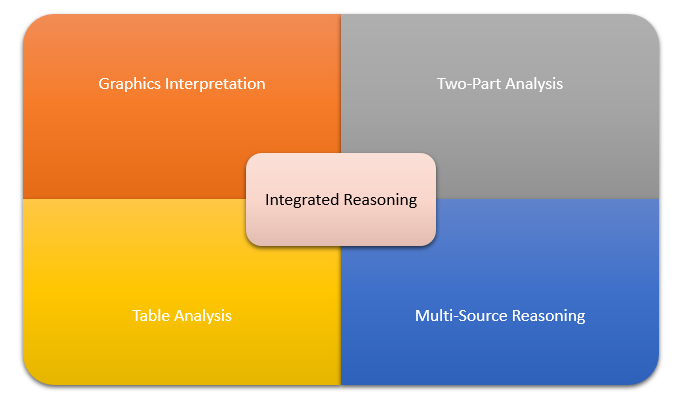
What is the Mini GMAT test format; www.gmac.com
Despite the fact that on surface the Leader Evaluation test seems to be a small rendition of GMAT, it is very unique in relation to the GMAT. Every one of the segments and sort of inquiry you have on GMAT likewise include on the Leader Appraisal test. The test isn’t just a short-hand form of the GMAT and there are numerous obvious contrasts between the two tests as is clear in the example papers delivered by GMAC.
Quick Links:
| About GMAT Exam | GMAT Registration |
| GMAT Exam Dates | GMAT Syllabus |
| GMAT Scores | GMAT Preparation Tips |
Related post
The total duration of the exam is 90 minutes and it consists of three sections, each of 30 minutes. Following table includes the section-wise topics covered in the EA exam:
| Section | Number of questions | Content | Score |
| Integrated Reasoning | 12 |
|
0 to 20 |
| Verbal | 14 |
|
0 to 20 |
| Quant | 14 |
|
0 to 20 |
| Total | 40 | 100 to 200 |
Since our knowledge currently depends only on the released sample question papers, it is hard to draw any certain conclusions, but certain things about the section syllabus. Quant section has no geometry questions, or functions, quadratic equations, combinatorics, overlapping sets, and probability questions either.
There is no guarantee that any of the missing questions will never appear on the exam. Most probably GMAC will be soon releasing additional guidelines related to the syllabus and content structure of Executive Assessment exam.
Mastering the Mini GMAT: A Comprehensive Guide to the Shorter Exam Format
In recent years, the Graduate Management Admission Council (GMAC) significantly restructured the GMAT to better align with the needs of modern business schools and candidates. The result is the GMAT Focus Edition, which has effectively become the standard format. While it is not formally referred to as a “Mini GMAT,” its streamlined, shorter design is precisely what candidates imply when using that term.
This guide explores everything you need to know about this efficient, high-stakes testing format.
What is the GMAT Focus Edition?
The GMAT Focus Edition is a condensed, more streamlined version of the traditional GMAT. It was designed to be less burdensome for test-takers while maintaining the same level of academic rigor and predictive validity that admissions committees require.
Key Structural Changes
-
Reduced Duration: The total exam time is approximately 2 hours and 15 minutes (excluding breaks and administrative time), down from the traditional 3+ hour format.
-
Fewer Questions: The total number of questions has been reduced to 64.
-
No Analytical Writing Assessment (AWA): The essay portion has been eliminated entirely.
-
No Geometry: The Quantitative Reasoning section no longer tests geometry, focusing instead on data-driven problem-solving.
The Three Core Sections
The exam is divided into three 45-minute sections. You have the flexibility to choose the order in which you complete them.
1. Quantitative Reasoning
This section assesses your ability to reason mathematically and solve quantitative problems.
-
Question Count: 21 questions.
-
Focus: Problem Solving.
-
Key Topics: Algebra and Arithmetic. The emphasis is on logical reasoning and practical application rather than complex geometric proofs.
2. Verbal Reasoning
This section evaluates your ability to understand, evaluate, and edit written material.
-
Question Count: 23 questions.
-
Focus: Reading Comprehension and Critical Reasoning.
-
Note: Sentence Correction questions—a staple of the old GMAT—have been removed, shifting the focus entirely toward critical analysis and logical interpretation of text.
3. Data Insights
This is the most innovative part of the “Mini” format, replacing the old Integrated Reasoning section.
-
Question Count: 20 questions.
-
Focus: Data sufficiency, multi-source reasoning, table analysis, graphics interpretation, and two-part analysis.
-
Importance: This section tests your ability to synthesize data from multiple sources—a critical skill for modern MBA curricula.
Strategic Advantages of the New Format
The shift to a shorter test provides several distinct advantages for the modern candidate:
| Feature | Impact on Test-Taker |
| Shorter Duration | Reduces mental fatigue and improves focus during the final sections. |
| No Essay | Allows more time to focus on high-yield analytical and reasoning skills. |
| Question Review | You can now bookmark questions and edit up to three answers per section, offering more tactical control. |
| Targeted Preparation | By removing niche topics like geometry and sentence correction, study time can be more efficiently allocated to core reasoning skills. |
Essential Preparation Tips
Given that the GMAT Focus Edition relies heavily on logical reasoning, your study approach should evolve.
-
Prioritize Data Literacy: Since the Data Insights section carries significant weight in your total score, do not treat it as an “afterthought.” Practice interpreting complex charts and multi-modal datasets.
-
Master “Question Review”: Learn to manage your time so that you have 2–3 minutes at the end of each section to review your bookmarked answers. Using this feature effectively can turn a few near-misses into correct answers.
-
Focus on Logic, Not Just Math: The exam is designed to test your ability to think under pressure. Use official prep materials from GMAC to familiarize yourself with the specific cadence and logic patterns of the Focus Edition.
-
Simulated Testing: Take full-length official practice exams under timed conditions to acclimate your brain to the 2-hour-and-15-minute rhythm.
Conclusion
The GMAT Focus Edition is a sophisticated, streamlined assessment tool that respects your time while demanding high-level cognitive performance. By understanding its structure—focusing on Quantitative Reasoning, Verbal Reasoning, and Data Insights—you can move away from rote memorization and toward the analytical thinking required to thrive in top-tier business programs.