
GMAT Role/Weight in Business School Applications: A Comprehensive Guide
The Graduate Management Admission Test (GMAT) has long been considered a cornerstone of business school admissions. As global competition for MBA and other graduate management programs intensifies, understanding the role and weight of the GMAT in the admissions process is essential for prospective applicants. This article explores the importance of the GMAT, how admissions committees use it, recent trends, and strategic guidance on how to approach this critical component of your application.
1. What Is the GMAT and Why Do Schools Use It?
- The GMAT is a standardized, computer-adaptive exam designed to measure analytical, quantitative, verbal, and data interpretation skills.
- It provides a common metric that allows admissions committees to compare applicants from diverse academic, professional, and geographic backgrounds.
- The test is administered by the Graduate Management Admission Council (GMAC) and is accepted by more than 2,300 business schools worldwide.
2. The GMAT’s Traditional Role in Admissions
Objective Measurement
- The GMAT offers business schools an objective benchmark against which to assess applicants’ academic readiness for rigorous management programs.
- Unlike undergraduate GPA—which can differ in meaning across institutions and countries—the GMAT provides a standard measure.
Predictive Value
- Multiple studies have shown a moderate correlation between GMAT scores and first-year MBA academic performance.
- While not a perfect predictor, schools use GMAT scores to gauge whether a candidate can handle the quantitative and analytical demands of the curriculum.
Screening Tool
- Many top schools set minimum GMAT “cutoff” scores or report the average/median score of recent incoming classes.
- A strong GMAT score can help your application stand out, particularly if your undergraduate background is less quantitative or your GPA is below average.
3. GMAT Weight in the Admissions Process
The weight of the GMAT can vary significantly by school, program, and even applicant profile, but several common factors apply:
Quantitative Weight
- Top-tier MBA programs: GMAT often accounts for 15%–25% of the admissions decision.
- Mid-tier and specialized programs: GMAT may be less central, sometimes as low as 10% of the total evaluation.
Holistic Review
- Most schools use a holistic admissions process: they consider work experience, undergraduate GPA, essays, recommendations, interviews, and GMAT/GRE scores together.
- However, a very low GMAT score can be a red flag, while a very high score may compensate for weaker elements elsewhere.
Benchmarks and Class Profiles
- Schools publish average, median, and middle 80% GMAT scores for admitted classes.
- Being at or above the median increases your chances, while being below can make admission challenging, especially at competitive schools.
4. How Admissions Committees Use GMAT Scores
Academic Readiness
- A strong score, especially in the Quantitative Reasoning section, signals you can cope with demanding MBA coursework.
Class Profile and Rankings
- Schools aim to maintain or improve their average GMAT scores for class rankings and reputation.
- Publications like U.S. News & World Report and Financial Times use average GMAT scores as a ranking metric.
Scholarships and Funding
- Many programs award merit-based scholarships in part or in whole based on GMAT scores.
- A high GMAT can enhance your financial aid offerings.
5. Recent Trends: The GMAT’s Changing Role
Rise of the GRE and Test-Optional Policies
- Many business schools now accept the GRE as an alternative to the GMAT.
- COVID-19 prompted some schools to introduce test-optional or test-flexible policies, though many have since reinstated test requirements.
Increasing Diversity in Class Profiles
- Schools are broadening their applicant pools and may weigh GMAT scores differently for candidates from non-traditional or underrepresented backgrounds.
GMAT Focus Edition
- The new GMAT Focus Edition (2024) shortens the test and emphasizes data analysis, adapting to modern business needs.
6. Strategic Advice: Approaching the GMAT in Your Application
Research Target Schools
- Check average and median GMAT scores for your target programs.
- Aim for a score at or above the published median, especially for top schools.
Contextualize Your Score
- Use essays and optional statements to contextualize a lower score (e.g., if English is not your first language or you have a highly quantitative career).
- Highlight strengths in other areas if your GMAT is not your strongest component.
Leverage a High Score
- A high GMAT can compensate for a lower GPA or less traditional work experience.
- Use it as a “spike” in your application portfolio to demonstrate academic aptitude.
Don’t Neglect Other Elements
- While important, the GMAT is only one part of your application.
- Work experience, leadership, recommendations, and a compelling personal story are equally vital.
7. FAQs: GMAT in Business School Admissions
Q: Can a high GMAT score guarantee admission?
A: No. It helps, but admissions decisions are holistic and consider all aspects of your application.
Q: Is a low GMAT score always a dealbreaker?
A: Not always, especially if other parts of your application are exceptional. Some programs allow you to explain extenuating circumstances.
Q: Should I retake the GMAT if my score is below my target school’s average?
A: If you believe you can significantly improve, retaking may be worthwhile, especially if your first attempt is well below the median.
8. Final Thoughts
The GMAT remains a critical piece of the business school admissions puzzle, providing a standardized way for schools to assess academic ability and compare applicants. While its weight varies by program and applicant, a strong GMAT can open doors to elite schools, scholarships, and impressive class profiles. However, remember that admissions are holistic—balance a strong test score with compelling essays, robust recommendations, and meaningful work experience for the best chance of admission.
Weight in Business School Applications; www.gmac.com
The GMAT should be viewed by prospective business students as very important to the success or failure of their applications. One major reason for this is the link between business school rankings and the average GMAT scores of an institution’s accepted students. Programs therefore have a strong incentive to accept students with the highest possible scores, and a drop in a school’s average GMAT scores is likely to lead to a decline in rank. The most admissions-relevant rankings in the United States are probably those provided by U.S. News & World Report. The methodology used by U.S. News devotes 25% of business school assessments to a category called “student selectivity.” Almost two-thirds of this category (and 16.25% of the total) is derived from GMAT total scores and GRE scores. Since most business schools do not report average GRE scores for their students, GMAT total scores make up the vast majority of the testing data. GMAT scores are the second-largest sub-category in the entire U.S. News rankings methodology, behind only the “peer assessment score” at 25%.
Forbes magazine also publishes a ranked list of business schools, which allows users to easily view tuition rates, average GMAT scores, average salaries, and typical five-year increases in compensation for MBAs (U.S. News publishes some of this data as well, but access requires a subscription). The methodology used by Forbes is based on the idea of “return on investment,” which has been criticized for prioritizing the top-tier schools. Bloomberg Businessweek is another source of business school rankings, and like the Forbes list, it does not consider admissions selectivity.
The GMAT and World Business School Rankings
Because the GMAT is only required or accepted in English-speaking countries, world business school rankings tend to avoid consideration of GMAT scores. The rankings published by the Financial Times, for example, use data drawn from surveys of business school alumni and are thus much more devoted to outcomes (employment, salary, etc.). Not surprisingly, these rankings often produce far different results than those complied by U.S. News. World rankings are worth examination, but prospective business school applicants should remember that they can be less than helpful in assessing selectivity of admission. Aspiring graduate business students would be well advised to gather as much information as possible on their preferred institutions, but they must not forget to emphasize all data that is relevant to acceptance.
Other Assessments of the GMAT’s Weight in Applications
The intense competition for acceptance to top business schools has led to the creation of an admissions consulting industry. These professionals provide advice intended to maximize their clients’ chances of submitting successful applications. The viability of this industry is completely dependent on getting results, and admissions consultants are intimately familiar with the business school application process. Both of these facts give admissions consultants some degree of credibility to comment on the important components of business school applications. In a recent survey of admissions consultants, 65% of respondents believed that the GMAT is now being given more weight than ever. They also estimated that the GMAT accounted for about 22% of admissions decisions, with total GMAT scores at 16% and quantitative scores at 6%. Other interviews with admissions consultants indicated that many believe the GMAT to be a better choice for applicants than the GRE, although there is some disagreement on this issue.
ALSO CHECK
- GMAT Colleges
- How to improve your GMAT scores to get into better colleges
- GMAT Score for MBA in Canada
- New GMAT Feature Allows Students To Choose The Order Of Sections
- New Feature on GMAT: Preview Your Scores
- Top Strategies for Getting a Perfect 800 GMAT Score
- GMAT Scholarships for Indian Students: Everything You Need To Know
- GMAT Cut Off for Top MBA Colleges in USA
- GMAT Preparation FAQs
- Preparation Tips for GMAT Quantitative (Quant) Section
- GMAT Math Prep FAQs
- Business Schools without GMAT requirement
- MBA Colleges in Australia that don’t Require GMAT
- MBA in Australia without GMAT FAQs
The GMAT’s Weight as Reflected in Average Scores at Selected Business Schools
Most business schools publish class profiles of their accepted students online, which include average GMAT scores and score ranges. Viewing these class profiles will allow a prospective business student to confirm the importance of the GMAT for himself or herself. There is an almost linear relationship between the selectivity of a given business school and the average GMAT total scores of successful matriculants. At the most highly ranked institutions, mean GMAT total scores are generally in the 90th percentile or above. These include the Stanford Graduate School of Business (average of 733), Harvard Business School (median of 730 with middle 80% scores of 690-760), the University of Chicago’s Booth School of Business (average of 726), the University of Pennsylvania’s Wharton School (mean of 731, median of 730, and middle 80% of 700-770), and Northwestern University‘s Kellogg School of Management (average of 726). Lower ranked programs report much lower GMAT scores. At the University of Kansas School of Business, which is outside the top 75 in the United States, the average GMAT score is 570. At the unranked University of Tennessee Chattanooga College of Business, the GMAT average is 500.
Demystifying the GMAT: What It Means for Your MBA Journey
If you are planning to advance your career, break into senior management, or pivot into an entirely new corporate sector, pursuing a Master of Business Administration (MBA) is likely at the top of your radar. However, as you begin researching top-tier business schools, one critical acronym will consistently appear: GMAT.
For many aspiring business leaders, understanding what the GMAT means and its weight in an MBA application is the first major milestone. This comprehensive guide breaks down everything you need to know about the GMAT, its role in MBA admissions, the structure of the modern exam, and how you can excel.
GMAT Meaning: What Does It Stand For?
GMAT stands for the Graduate Management Admission Test. It is a standardized, computer-adaptive test designed specifically for business school applicants. Administered by the Graduate Management Admission Council (GMAC), the exam evaluates higher-order reasoning, data analysis, and critical thinking skills rather than rote memorization or specific business knowledge.
Unlike general graduate entrance examinations, the GMAT is tailor-made for the business world. It assesses how well you analyze variables, solve complex problems under strict time constraints, and make logical decisions—all skills that are vital for success in an MBA program and a corporate boardroom.
Why Is the GMAT Important for an MBA?
The relationship between the GMAT and an MBA is deeply structural. Business school admissions committees (AdComs) receive thousands of applications from candidates globally with completely different backgrounds, undergraduate majors, grading systems, and career tracks.
The GMAT serves several crucial purposes in the MBA admissions ecosystem:
1. A Uniform Benchmarking Tool
An applicant with an Engineering degree from a rigid technical institute and an applicant with a Liberal Arts degree from a small college cannot easily be compared on GPA alone. The GMAT provides a uniform, objective metric that allows admissions committees to evaluate all applicants on a completely level playing field.
2. Predictor of Academic Rigor
Extensive data collected over decades shows a strong correlation between competitive GMAT scores and academic success during the core first year of an MBA program. Because MBA curriculums are quantitatively demanding, schools use your score to ensure you have the analytical capacity to handle core courses like finance, corporate accounting, and statistical analysis.
If you are looking to balance your preparation or require structural advice on navigating academic workloads during your admissions prep, platforms like StudentArrive Exploration and Journalists provide customized data presentations, research help, and academic writing assistance specialized for Masters and MBA scholars.
3. Impact on Business School Rankings
Major publications that rank global MBA programs factor the average GMAT score of an incoming class into their ranking algorithms. Therefore, schools are naturally incentivized to admit candidates with strong GMAT scores to maintain or elevate their academic prestige and global standing.
4. Financial Aid and Merit Scholarships
Pursuing a top-tier MBA is a massive financial commitment. Many business institutions utilize GMAT scores as a primary baseline for awarding institutional, merit-based scholarships and fellowships. A stellar score can significantly lower your tuition burden.
The Modern Blueprint: The GMAT Focus Edition
If you are researching the GMAT today, you need to understand its current format. The exam transitioned entirely to the GMAT Focus Edition, a shorter, more streamlined version designed to reflect the exact digital and analytical demands of today’s corporate landscape.
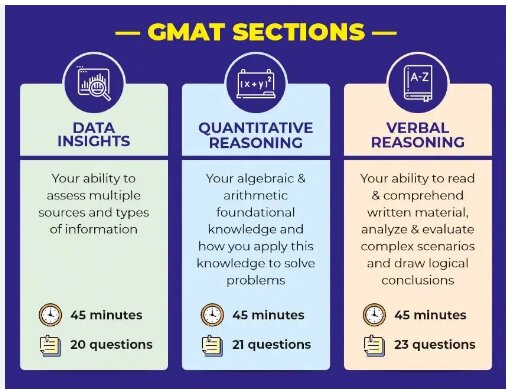
The legacy essay portion (Analytical Writing Assessment) has been completely removed. The modern exam consists of three core sections, which you can complete in any order:
-
Quantitative Reasoning (21 Questions, 45 Minutes): This section measures your foundational mathematical proficiency and arithmetic/algebraic problem-solving abilities. Notably, geometry has been removed from this version to focus purely on practical math and logic.
-
Verbal Reasoning (23 Questions, 45 Minutes): This section assesses your ability to read, interpret, and critically evaluate written arguments. It focuses heavily on Critical Reasoning and Reading Comprehension.
-
Data Insights (20 Questions, 45 Minutes): A section dedicated to digital data literacy. It requires you to analyze, interpret, and synthesize complex data presented in charts, graphs, tables, and multi-source case formats. An on-screen calculator is permitted exclusively during this section.
Understanding the GMAT Scoring System
The GMAT Focus Edition features a total score scale ranging from 205 to 805, with all final scores ending in a 5. Each of the three sections is weighted equally and scored on a scale from 60 to 90.
Because the scoring scale changed with the Focus Edition, applicants should focus on percentiles rather than old legacy scores. For example, a 645 on the GMAT Focus Edition puts you roughly in the 86th percentile, making it a highly competitive score for many top-tier business institutions globally.
GMAT vs. GRE: Which Should You Take?
While the GMAT is the traditional standard for business schools, almost all global MBA programs now accept the GRE (Graduate Record Examination) as an alternative.
-
Choose the GMAT if: You possess sharp analytical and data-driven skills, and you intend to apply exclusively to business schools or target highly quantitative post-MBA careers like investment banking, private equity, or strategic management consulting.
-
Choose the GRE if: You have an exceptionally strong vocabulary, prefer a more traditional test format, or want to keep your options open for other non-business graduate programs (such as a Master’s in Public Policy).
A Winning GMAT Preparation Strategy
Achieving a top-percentile score requires discipline, structure, and targeted effort. On average, successful applicants dedicate 100 to 150 hours over a 3-to-6-month window. Here is how you should approach it:
-
Establish Your Baseline: Before purchasing study guides, take a free, official GMAT Focus practice exam on the MBA.com portal to find your baseline diagnostic score.
-
Master the Core Concepts: Don’t just blindly answer questions. Take time to thoroughly review underlying logic, algebraic principles, and data interpretation strategies.
-
Practice with Authentic Materials: The best practice questions are past questions authored by GMAC itself. Utilize the GMAT Official Guide bundles to get used to the computer-adaptive nature of the exam.
-
Analyze Mistakes Deeply: Spending 30 minutes analyzing why you got a single question wrong is vastly more valuable than rushing through twenty practice questions without reviewing them.
For candidates managing dense work schedules who need support structuring their essays, statement of purpose, or academic entry profiles alongside test prep, leveraging professional academic resources can streamline your path. Check out the professional support infrastructure available at StudentArrive to maximize your postgraduate preparation efficiency.
Conclusion
The GMAT is much more than a simple admissions hurdle; it is a critical pillar of your MBA application portfolio. A strong GMAT score acts as a powerful signal to admissions committees that you possess the intellectual stamina, analytical precision, and data-driven mindset necessary to thrive in an elite business program. Define your target score, map out your study routine, and take your first step toward transforming your global business career.