
What is SAT Subject Test; www.collegeboard.org
Latest update: SAT Subject Tests will be discontinued for international students after June 21.
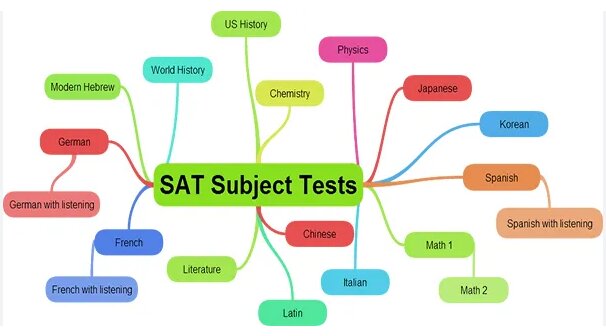
A lot has been talked about SAT General Tests. However, today we will discuss all SAT Subject Tests. Broadly speaking, SAT Subject Test is divided into 5 subjects. These subjects are further categorized into smaller topics. The various SAT Subjects include:
- Mathematics
- Science
- English
- History and
- Languages
SAT Subject Test vs SAT General Test
SAT 1 vs SAT 2 – Subject Test or SAT 2 is a more subject-focused test. Candidates looking to apply to a particular course in a college can take the SAT Subject Test to exhibit his knowledge and understanding of that particular subject. The SAT General Test, on the other hand, has been developed to evaluate the written, verbal and mathematical skills of the candidates seeking admission to undergraduate schools. The Scholastic Assessment Test is conducted by The College Board.
SAT Mathematics Subject Test
The Mathematics subject is divided into 2 levels,
- Math Level 1
- Math Level 2
SAT Mathematics Level 1 and Level 2 are for candidates who are looking to study in similar fields pertaining to mathematics. The main difference between the syllabuses for the SAT Math Subject Tests is that while the Math Level 2 has all the subjects covered in Level 1 along with the inclusion of trigonometry and elementary functions (precalculus). Candidates can check out the detailed SAT Mathematics Syllabus for SAT Math Level 1 and SAT Math Level 2 below.
SAT Subject Test Mathematics – Math Level 1
| Particulars | Syllabus |
| Questions: 50 (multiple choice)Duration: 60 minutesPoints: 200-800 | Number and Operations Algebra and functionsGeometry and measurement (plane Euclidean, coordinate, three-dimensional, and trigonometry)Data analysis, statistics, and probability |
SAT Subject Test Mathematics – Math Level 2
| Particulars | Syllabus |
| Questions: 50 (multiple choice)Duration: 60 minutesPoints: 200-800 | Number and operationsAlgebra and functionsGeometry and measurement (coordinate, three-dimensional, and trigonometry)
Data analysis, statistics, and probability |
Confused between SAT Mathematics Level 1 and Level 2: Candidates who are confused between the two should opt for the one that they are most familiar with. Candidates who have shown extraordinary skills in trigonometry or elementary functions (precalculus) or both should opt for SAT 2 Math whereas candidates looking to score high points and not so familiar with topics covered in level 2 should opt for SAT 1 Math. It is important to factor in the requirement of the candidates’ University and Programme of choice.
SAT Science Subject Test
The SAT Science Subject is further classified into
- Biology E/M
- Chemistry
- Physics
SAT Subject Test Biology E/M
Candidates who are opting for SAT Biology Ecological or Biology Molecular are basically inclined towards pursuing Science in their higher education. This section of SAT tests candidates on their knowledge of diversity, evolution, concepts around micro-level biology and other major concepts that they would have read in their high school. The SAT Science paper tests the candidates on their fundamental concepts and knowledge, application processes and Interpretation skills.
SAT Science – Biology E/M
| Particulars | Syllabus |
| Questions: 80 (multiple choice)Duration: 60 minutesPoints: 200-800 | Cellular and molecular biologyGeneticsOrganismal biology
Evolution and diversity |
SAT Subject Test Chemistry
SAT Chemistry Subject Test evaluates the candidates’ understanding of major concepts of chemistry and their ability to apply these principles to solve specific problems. This section of the test measures the fundamental concepts, application, and synthesis of knowledge of the candidate.
SAT Science – Chemistry
| Particulars | Syllabus |
| Questions: 85 (multiple choice)Duration: 60Points: 200-800 | Structure of matterReaction typesStoichiometry
Equilibrium and reaction rates Thermochemistry Laboratory Descriptive chemistry States of matter |
SAT Subject Test Physics
SAT Physics Subject Test measures the candidates’ understanding of concepts of introductory physics on as well as reasoning and problem-solving skills derived from lab experience. This particular section evaluates the candidates’ knowledge of fundamental concepts and his ability to solve single and multi-concept problems.
| Particulars | Syllabus |
| Questions: 75 (multiple choice)Duration: 60Points: 200-800 | MechanicsElectricity and magnetismHeat and thermodynamics
Modern physics Miscellaneous Waves and optics |
ALSO CHECK
- SAT Test and Training Centers in Nigeria
- SAT Test Centers and Dates in Burkina Faso
- SAT Test Centers and Dates in Cameroon
- SAT Test Centers and Dates in Republic of the Congo
- SAT Test Centers and Dates in Egypt
- SAT Test Centers and Dates in Eritrea
- SAT Test Centers and Dates in Ethiopia
- SAT Test Centers and Dates in Gabon
- SAT Test Centers and Dates in Gambia
SAT English Subject Test
SAT English Subject Test allows candidates to highlight their strength in reading and interpreting literary texts from a variety of historical periods and genres. Candidates are mostly required to solve questions from prose passages, primary excerpts from fiction, essays, poetry, and drama.
| Particulars | Syllabus |
| Questions: 60 (multiple choice)Duration: 60Points: 200-800 | American literatureEnglish literatureOther literature is written in English |
SAT History Subject Test
The SAT History Subject is further classified into
- US History
- World History
SAT US History Subject Test
Candidates looking to appear for this section of the exam are required to showcase their grasp of history since pre-Columbian times.
| Particulars | Subjects |
| Questions: 90 (multiple choice)Duration: 60Points: 200-800 | Political historyEconomic historySocial history
Intellectual and cultural history Foreign policy |
SAT World History Subject Test
Candidates looking to appear for this section of the exam are required to showcase their grasp of developments across the globe since ancient times.
| Particulars | Subjects |
| Questions: 95 (multiple choice)Duration: 60Points: 200-800 | Global or comparativeEuropeAfrica
Southwest Asia South and Southeast Asia East Asia The Americas |
SAT Languages Test
Candidates appearing for the SAT Language Test is required to highlight their understanding of the particular language through the writing or/and speaking methods. The languages for which candidates can appear for the exam are mentioned below. Candidates appearing for the listening exam will be allowed 20 minutes for listening questions and 40 minutes for reading questions out of the total 60 minutes duration.
| Particulars | Languages |
| Questions: 85 (multiple choice)Duration: 60 minutesPoints: 200-800 | SpanishSpanish with ListeningFrench with listening
Chinese with listening Italian German German with listening Modern Hebrew Latin Japanese with listening Korean with listening |
SAT Subject Test Scores
A Comprehensive Guide to SAT Subject Tests and Their Scores
It is essential to start with a critical update for any student or researcher looking into this topic: The College Board officially discontinued all SAT Subject Tests in January. Because these tests are no longer administered, you cannot register for them, take them, or earn new scores. However, because this is a significant part of educational history and some admissions processes still reference them, understanding their legacy, scoring structure, and how they functioned is valuable for historical context or if you are dealing with older academic records.
- SAT Test Centers and Dates in Ghana
- SAT Test Centers and Dates in Kenya
- SAT Test Centers and Dates in Liberia
- SAT Test Centers and Dates in Madagascar
What Were the SAT Subject Tests?
The SAT Subject Tests were a series of one-hour, multiple-choice exams designed to measure a student’s knowledge and proficiency in specific academic areas. Unlike the general SAT, which assesses broad critical reading, writing, and mathematical skills, the Subject Tests were highly focused on individual disciplines.
The Five Core Subject Categories
The tests were grouped into five broad themes:
-
English: Literature.
-
History: U.S. History and World History.
-
Languages: Spanish, French, Chinese, Italian, German, Modern Hebrew, Latin, and others (some with listening components).
-
Mathematics: Math Level 1 and Math Level 2.
-
Science: Biology (E/M), Chemistry, and Physics.
Understanding the Scoring System
When the tests were active, the scoring system was distinct from the general SAT.
The 200–800 Scale
Each Subject Test was scored on a scale ranging from 200 to 800, in 10-point intervals. This scale allowed admissions officers to see a student’s mastery of a specific subject relative to other students who took that same specific test.
How Scores Were Calculated
The scoring process was unique and often involved “negative marking,” which discouraged random guessing.
-
Correct Answers: Received 1 point.
-
Omitted Questions: Received 0 points (no penalty).
-
Incorrect Answers: Resulted in a fraction of a point deduction:
-
1/4 point subtracted for 5-choice questions.
-
1/3 point subtracted for 4-choice questions.
-
1/2 point subtracted for 3-choice questions.
-
This system was designed to ensure that the final score reflected a student’s actual knowledge rather than their ability to guess successfully.
Historical Role in College Admissions
Colleges and universities previously utilized these scores to gain a more granular understanding of a student’s academic background.
| Role | Description |
| Placement | Scores helped universities determine if a student was ready for advanced coursework or could test out of introductory requirements. |
| Admissions Context | They served as a validation of high school grades, particularly for applicants from schools where grading standards might be less familiar to admissions officers. |
| Major-Specific Requirements | Highly competitive programs (especially in Engineering or Pre-Med) often recommended or required specific Subject Tests to confirm a candidate’s readiness for rigorous curricula. |
Legacy and Current Status
Since the discontinuation, the landscape of college admissions has shifted significantly. Most institutions have moved toward “test-optional” or “test-blind” policies, placing greater emphasis on high school coursework, AP/IB/A-Level exam scores, portfolios, and personal statements.
If you are currently applying to college, you do not need to worry about taking these tests. If you are reviewing a student profile that includes these scores from prior, they remain a valid—though historical—data point indicating a student’s academic interests and mastery at that time.
Key Takeaways for Students
-
Check Admissions Requirements: Always prioritize the specific requirements of the institutions you are interested in.
-
Focus on Current Assessments: Since Subject Tests are gone, focus your energy on demonstrating academic excellence through current high school coursework and recognized national/international assessments (like Advanced Placement or IB exams).
-
Data Integrity: If you have old scores, they may still be available via your College Board account, but they are unlikely to influence modern admissions outcomes in the same way they once did.