
GMAT Integrated Reasoning Preparation Tips: How to Improve GMAT Integrated Reasoning Score; www.gmac.com
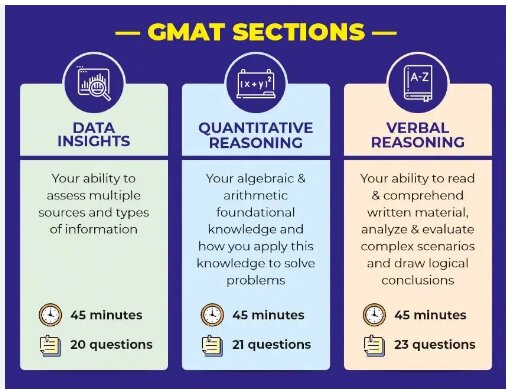
To succeed in the business world, you’ll need to analyze information from a variety of sources, develop strategies and make decisions from that information. Integrated reasoning section of GMAT is meant to measure your ability to evaluate information presented in multiple formats, from multiple sources – skills you already use, and skills you need to succeed in this data-rich world.
- Time: 30 minutes
- Format: 12 questions
- Tests: Table Analysis, Graphics Analysis, Two-Part Analysis, and Multi-Source Reasoning
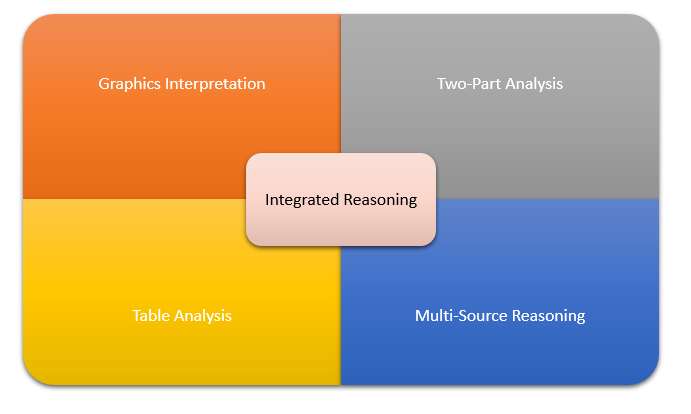
The Integrated Reasoning section consists of four question types, which require you to analyze data in different formats and from multiple sources.
- Graphics Interpretation – Interpret the graph or graphical image and select the option from a list to make the answer statements accurate.
- Two-Part Analysis – Select one answer from each column to solve a problem with a two-part solution. Possible answers will be presented in a table with a column for each part.
- Table Analysis – Sort the table to organize the data so you can determine whether certain conditions are met. Each question will have statements with opposing answers. Select one answer for each statement.
- Multi-Source Reasoning – Click on the page to reveal different data and recognize which data you need to answer the question.
Here are the current percentile rankings for the 1 to 8 IR scoring scale:
| Percentile | Score |
|---|---|
| 92% | 8 |
| 81% | 7 |
| 67% | 6 |
| 52% | 5 |
| 37% | 4 |
| 24% | 3 |
| 12% | 2 |
| 0% | 1 |
GMAT IR: Skills Measured
- Analyzing information presented in graphics, text, and numbers
- Assimilating relevant information from different sources
- Organizing information to see relationships, to solve multiple interrelated problems
- Combining information to solve complex problems that depend on information from one or more sources
Related post
- How to improve your GMAT scores to get into better colleges
- GMAT Score for MBA in Canada
- New GMAT Feature Allows Students To Choose The Order Of Sections
- New Feature on GMAT: Preview Your Scores
- Top Strategies for Getting a Perfect 800 GMAT Score
- GMAT Scholarships for Indian Students: Everything You Need To Know
- GMAT Cut Off for Top MBA Colleges in USA
- GMAT Preparation FAQs
GMAT IR Questions: Things you should know
The Integrated Reasoning section involves questions from both Quantitative and Verbal Reasoning separately or mixed. Some of the questions require more than one response.
- All answer choices for a single question are presented on the same screen
- Submit responses to all parts before moving to the next question
- Answer all parts of a single question correctly, so, you receive credit. As no partial credit is given
- One cannot go back and change the answer after answering a question
- Some questions may include a set of data or a graphic. In case you answer a question incorrectly then it does not mean that all other questions of the same pattern will be incorrect
- Questions might contain quantitative data, however, it is not a quantitative skills test. An online calculator having basic functionality may be available, but not necessary for this section.
GMAT IR Tips: Graphics Interpretation
Graphics interpretation question require a candidate to answer questions that are accompanied with charts and graphs.
- Candidate must read the text carefully
- Do not lose sight of the units of measurement
- You must practice the art of finding relationships between the data that has been presented
- Be careful about absolute increase/ decrease, percentage increase/ decrease, trends, correlation, etc.
GMAT IR Tips: Table Analysis
These questions are presented with a data set in a table that you can sort by column. Answers will be a set of statements having two opposing answer options either in Yes/No or True/False.
- Examine the table and the text to get the type of given information
- Go through the question carefully to determine the data analysis required and know the choice you have to make
- Check whether the given condition can be met
GMAT IR Tips: Two-Part Analysis
In these questions, a brief scenario or problem and you have to select two answer choices related to the data. The answer choices will be connected to each other in some or another way.
- Go through the information carefully that may include verbal, quantitative content, or a combination of both. Even if you are familiar with the subject matter, make sure it does not influence your response. Also, use only the data presented in the question.
- Check what exactly is the question is asking. At times, the response columns do not have enough details that can help you understand what you need to do.
- Review the choices available before deciding the answer. Check whether the tasks are dependent or independent. Few questions have two tasks that can be handled individually while others may have one task with two dependent parts.
- Make sure that the same answer choice is the correct response for both columns. One answer option may be true for both the response columns.
GMAT IR Tips: Multi-Source Reasoning
In Multi-Source Reasoning question, there are 2-3 tabs where the data is provided in the form of text/ table/ graph. Other half of the screen will have the corresponding question (MCQ, Yes/ No, True/ False, etc.)
- Quickly go through the data and then read the question. This will help you save time since you know where to look for the data
- You can follow RC strategy of summarizing the content
- You can divide your rough paper into 2-3 columns and summarize the data over there
GMAT IR Tips: Guidelines
Here are some tips to guide you through this new section of GMAT exam:
- Sharpen your time management skills to make sure you attempt all the questions and sub-questions.
- Write down notes of each tab as it will help you keep track of the volumes of information in multi-source reasoning.
- For table analysis questions, don’t waste a lot of time reading the introductory paragraph. Instead jump to the question and table immediately because everything you need comes from the table.
- Very carefully read the introductory paragraph of the two-part analysis questions.
- Look at the answer options in the menu for graphics interpretation questions before you start analyzing the question.
- Check the value of each increment on the axes of bar and line graphs so you calculate accurately.
- Prepare yourself for the online calculator by practicing with the calculator installed on your computer.
Mastering the GMAT Integrated Reasoning Section: A Comprehensive Guide
The Integrated Reasoning (IR) section of the GMAT is often perceived as a hurdle, but with the right strategy, it can become a pillar of your overall score. Unlike the quantitative or verbal sections, IR tests your ability to synthesize data from multiple sources—a skill that is directly reflective of the challenges you will face in business school and your professional career.
While some business schools place less weight on IR than on the Quant and Verbal sections, a strong performance signals that you possess the analytical agility required for rigorous MBA coursework.
1. Understand the Anatomy of the IR Section
To conquer IR, you must first understand its structure. The section consists of 12 questions to be completed in 30 minutes. You will encounter four distinct question types:
-
Multi-Source Reasoning (MSR): You are presented with two or three tabs of information (emails, memos, charts, or tables). You must toggle between them to answer questions.
-
Table Analysis: You are given a sortable table. You must use the sorting feature to organize data and answer questions, often involving simple calculations or logical inferences.
-
Graphics Interpretation: You must interpret various types of graphs (bar charts, scatter plots, bubble charts) to identify relationships or specific values.
-
Two-Part Analysis: These problems require you to select two answers that satisfy a set of constraints. These are often the most complex and time-consuming questions.
2. Core Strategies for Success
Master Data Synthesis
The primary challenge of IR is not complex math—it is the sheer volume of data. You are often given far more information than you need.
-
Identify the Goal: Before looking at the data, read the question carefully. Know exactly what you are being asked to find.
-
Filter Out Noise: Ignore data points that are irrelevant to the specific question at hand. This is the hallmark of an effective manager.
Become Comfortable with the Interface
The GMAT IR section features unique interactive elements, such as the ability to sort tables and use a dropdown menu system.
-
Practice with Official Software: Use the GMAT Official Starter Kit to familiarize yourself with the interface. The goal is to make the act of clicking and sorting second nature, so you aren’t wasting mental energy on mechanics during the test.
-
Use the Calculator Wisely: An on-screen calculator is provided. However, use it only for complex arithmetic. Relying on it for simple addition or subtraction will slow you down.
- GMAT Math Prep FAQs
- Business Schools without GMAT requirement
- MBA Colleges in Australia that don’t Require GMAT
- MBA in Australia without GMAT FAQs
- GMAT Sample Papers
Time Management is Non-Negotiable
With only 30 minutes for 12 questions, you have an average of 2.5 minutes per question.
-
The 30-Second Rule: If you are reading a prompt and have no idea how to approach it after 30 seconds, make an educated guess and move on. Getting stuck on one complex multi-part question will destroy your pace for the remainder of the section.
-
Strategic Skipping: Some questions are designed to be time-sinks. Recognize when a question requires multiple layers of calculation and decide early if it is worth your time.
3. Targeted Skill Development
Sharpen Your Statistical Literacy
IR often tests your ability to read and interpret charts. You should be comfortable with:
-
Trends and Outliers: Quickly identifying the direction of a line graph or spotting anomalies in a scatter plot.
-
Ratios and Percentages: Practice performing mental calculations with these, as they appear frequently.
-
Weighted Averages: Understand how to calculate these, as they are a common point of error for many test-takers.
Improve Your Reading Speed
In MSR questions, you may be presented with several paragraphs of text.
-
Active Reading: Don’t read for comprehension as you would in a novel. Read for structure. Ask yourself: Why is this email here? What is the main point of this report?
-
Cross-Referencing: Practice jumping between sources. When you see a data point, try to find the corresponding value or contradiction in another tab immediately.
4. The “Two-Part” Approach
Two-part analysis questions are unique because they often require you to satisfy two conditions simultaneously.
-
Solve Systematically: Write down the constraints for each part separately. Often, the two parts are linked by a single variable; finding that variable is the key to unlocking the entire problem.
-
Test Answers: If you are stuck, use the answer choices to work backward. Plug in the provided options to see if they satisfy the logic of the problem.
5. Recommended Study Routine
-
Diagnostic: Take an official IR practice test to identify your weakest question type.
-
Drill by Type: Spend two weeks focusing exclusively on your weakest question type (e.g., MSR).
-
Timed Sets: Once you have mastered individual types, take timed sets of 12 questions using official material.
-
Review Logic: For every question you miss, do not just look at the correct answer. Re-trace the path you took and identify the exact moment your logic failed. Did you misread a label? Did you overlook a tab?
By consistently applying these techniques, you will transition from merely “doing” the questions to “mastering” the data, turning the Integrated Reasoning section into a predictable and manageable part of your GMAT journey.
Similar posts;
- Premium GMAT Study Collection
- Preparation Tips for GMAT Quantitative (Quant) Section
- GMAT Math Prep FAQs
- Business Schools without GMAT requirement
- MBA Colleges in Australia that don’t Require GMAT
- MBA in Australia without GMAT FAQs
- GMAT Sample Papers
- Premium GMAT Study Collection
- GMAT Sample Questions: Analytical Writing SectioC
- GMAT Sample Questions Verbal Skills Section
- GMAT Verbal Preparation Tips: How to Improve GMAT Verbal Score
- Free GMAT Practice Questions