
GRE Syllabus
GRE Syllabus 2026: Candidates wanting to pursue graduate studies abroad are required to qualify for their Graduate Record Examinations (GRE) and achieve good scores. In order to do so, candidates must be well versed with the latest GRE syllabus, to begin with. Candidates can check out the latest GRE Syllabus 2026 and the GRE Exam Pattern as they read along. Candidates looking for GRE preparations tips, can opt for our GRE Preparation guide or follow our GRE 4-week study plan to ace their next GRE exam. Read on to know more about GRE Exam Syllabus 2026.
In response to the ongoing pandemic, COVID-19, ETS (Educational Testing Service) in their endeavour to make the GRE exam more accessible has launched the GRE at Home facility, where students can take the GRE exam from the safety of their homes. ETS has also allowed candidates to use their Aadhar Cards as part of their student ID starting July 1, 2021, during the GRE registration process. Candidates can know more about this as they read along.
GRE Test Formats
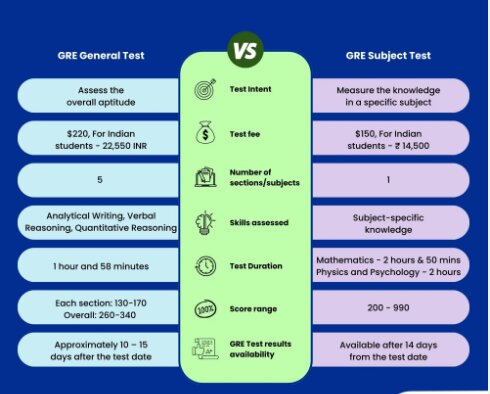
The GRE exam has two test formats – GRE General Test and GRE Subject Test. The GRE syllabus is different for each.
- GRE General Test: General Test is the standard exam that tests students’ verbal reasoning, quantitative reasoning, and analytical writing skills.
- GRE Subject Test: For more specific courses a GRE Subject Test might be required by the college, as the GRE Subject Test focuses on judging the candidate’s expertise in specific fields.
GRE Exam Syllabus 2026
GRE Exam Syllabus: Here is the GRE Syllabus 2026 covering the GRE writing syllabus, GRE verbal syllabus, and GRE quant syllabus:
GRE Syllabus 2026
| GRE Exam Pattern | Number of Questions | Allotted Time |
|---|---|---|
| GRE Analytical Writing SectionQuestion type: Analyze an Issue task and Analyze an Argument task. | 1 + 1(One “Analyze an Issue” task and one “Analyze an Argument” task) | 60 mins(30 minutes per task) |
| GRE Verbal Reasoning SectionQuestion type: Reading Comprehension, Text Completion and Sentence Equivalence. | 20 + 20(Two sections with 20 questions per section) | 60 mins(30 minutes per section) |
| GRE Quantitative ReasoningQuestion type: Quantitative Comparison Questions, Multiple-choice Questions and Numeric Entry Questions | 20 + 20(Two sections with 20 questions per section) | 70 mins(35 minutes per section) |
What are the Skills Tested in GRE?
- Analytical Writing Assessment (AWA)
- Quantitative Reasoning
- Verbal Reasoning
GRE Exam Syllabus: Analytical Writing (AWA) Section
The GRE analytical writing section aims to measure the test taker’s ability to articulate complex ideas clearly and effectively, support ideas with relevant reasons and examples, examine claims and accompanying evidence, sustain a well-focused, coherent discussion and control the elements of standard written English. The syllabus for GRE Analytical Writing includes two separately timed analytical writing tasks of thirty minutes each:
- Analyze an Issue
- Analyze an Argument
GRE Exam Syllabus: Verbal Reasoning Section
The verbal reasoning section aims to measure the test taker’s ability to analyze and draw conclusions from the discourse, reason from incomplete data, identify the author’s assumptions and/or perspective, select important points, distinguish major from minor or relevant points, summarize text, understand the structure of a text, understand the meanings of words, sentences and entire texts and understand relationships among words and concepts.
List of topics covered under the GRE verbal syllabus includes
- Basic Sentence structure: Nouns, Pronouns, Adjectives
- Verb Tense
- Idioms & Idiomatic Expressions
- Pronoun Agreement
- Subject-Verb Agreement
- Modifiers
- Parallelism
GRE Exam Syllabus: Quantitative Reasoning Section
The quantitative reasoning section aims to measure the test taker’s ability to understand quantitative information, interpret and analyze quantitative information, solve problems using mathematical models, and apply basic mathematical skills and elementary mathematical concepts of arithmetic, algebra, geometry, probability, and statistics.
List of topics covered in the GRE Quant Syllabus includes the following
| Ratio and proportion | Profit and loss |
| Simple and compound interest | Speed, distance and time |
| Permutation & combination | Linear equations |
| Quadratic equations | Sets Theory |
| Statistics | Powers and roots |
| Probability | Pipes, cisterns, work, time |
| Lines and angles | Triangles |
| Polygon | Quadrilateral |
| Circles | Coordinate geometry |
| Order of operations | Volume and surface area |
| Percentage | Number properties |
GRE Subject Test Syllabus 2026
GRE exam syllabus for Subject Test consists of the following subjects:
GRE Biology Syllabus (Discontinued since May 2021)
The test consists of approximately 190 five-choice questions related to Biology. The topics include:
- Cellular and Molecular Biology
- Organismal Biology
- Ecology and Evolution
GRE Chemistry Syllabus
The test consists of approximately 130 multiple-choice questions related to the four fields into which chemistry has been traditionally divided
- Analytical Chemistry
- Inorganic Chemistry
- Organic Chemistry
- Physical Chemistry
GRE Literature in English Syllabus (Discontinued since May 2021)
Each edition of the test consists of approximately 230 questions on poetry, drama, biography, the essay, the short story, the novel, criticism, literary theory, and the history of the language.
- Literary Analysis
- Identification
- Cultural and Historical Contexts
- History and Theory of Literary Criticism
GRE Math Syllabus
The test consists of approximately 66 multiple-choice questions drawn from courses commonly offered at the undergraduate level.
- Algebra
- Calculus
- Additional Topics
GRE Physics Syllabus
The test consists of approximately 100 five-choice questions, some of which are grouped in sets and based on such materials as diagrams, graphs, experimental data, and descriptions of physical situations.
- Classical Mechanics
- Electromagnetism
- Optics and Wave Phenomena
- Thermodynamics and Statistical Mechanics
- Quantum Mechanics
- Atomic Physics
- Special Relativity
- Laboratory Methods
- Specialized Topics
GRE Psychology Syllabus
The test consists of approximately 205 multiple-choice questions. Each question in the test has five options from which the examinee is to select the one option that is the correct or best answer to the question.
- Biological
- Cognitive
- Developmental
- Social
- Clinical
- Measurement/Methodology/Other
GRE General Test Pattern
GRE Exam Pattern: Even though one is aware of the GRE Syllabus and knows all the answers, failure to manage time can lead to an incomplete exam. This is where the importance of being familiar with the GRE Exam pattern is of utmost importance. The GRE exam syllabus is divided into three main sections, namely, Analytical Writing, Verbal Reasoning, and Quantitative Reasoning. The total time given to complete the GRE computer-based test is three hours and 45 minutes.
GRE Exam Pattern for Computer-Delivered Test
For the computer-based pattern, each of these sections is further divided into two sub-sections with forty questions in total (Verbal Reasoning and Quantitative Reasoning). GRE Analytical Writing has only one section that contains two tasks with a time duration of one hour. Apart from these main sections, there are two other variable sections included in the computer-based pattern exam. This section is followed by a ten-minute break after the Quantitative Reasoning part is complete. However, these two variable sections- Unscored and Research section- are not included in the final GRE Scores.
You May also like:
- IELTS Registration (How to Book a Test)
- IELTS Exam Dates FAQ
- How to Choose IELTS Test Dates
- How to Send IELTS Scores to Colleges
| GRE Sections | No. of Sections | Duration |
|---|---|---|
| Analytical Writing | 1 section- two tasks | 60 minutes |
| Verbal Reasoning | 2 section- 40 questions | 60 minutes |
| Quantitative Reasoning | 2 section- 40 questions | 70 minutes |
| Unscored | Varies | Varies |
| Research | Varies | Varies |
GRE Exam Pattern for Paper-Delivered Test
The paper-based GRE exam syllabus includes two sub-sections of each of the main categories- Analytical Writing, Verbal and Quantitative Reasoning. The analytical Writing part contains two tasks with a duration of one hour (60 mins). Verbal and Quantitative reasoning each contains two sections and 50 questions with a maximum time limit of 60 and 70 minutes, consequently. The variable sections of Unscored and Research are not included in the paper-based exam.
| GRE Sections | No. of Sections | Duration |
|---|---|---|
| Analytical Writing | 2 sections- 2 tasks | 60 minutes |
| Verbal Reasoning | 2 sections- 50 questions | 70 minutes |
| Quantitative Reasoning | 2 sections- 50 questions | 80 minutes |
| Unscored | NA | NA |
| Research | NA | NA |
Strategy for preparing for GRE
GRE preparation strategy: Candidates looking to prepare for their GRE syllabus can check out our detailed preparation guide on the various sections in GRE. Candidates can also benefit from downloadable sample GRE questions for the benefit of the test taker.
Best Books for GRE Preparation
In order to do well in your GRE General Test, it is important to be updated with the latest GRE Syllabus. The costs of studying and preparing for the GRE exam plus the application costs add up to a lot of expenses. The GRE Exam Fee for Indian students alone stands at US$213. If you are taking coaching classes, even then you will need to purchase an official GRE guide and practice tests. So it doesn’t make a difference whether you will be taking coaching classes or you believe in self-studying; you will need to purchase a few resources to practice GRE sections. So here are the best resources to boost your studies that cover the latest syllabus of GRE. Read: GRE One Month Preparation Plan
GRE POWERPREP II Software – Preparation for the Computer-based GRE revised General Test – Along with the sample questions, strategies, and tips, this free software includes two full-length practice tests. They have timed tests, which simulate the test-taking experience including the user-friendly design features like changing answers within a section, as well as an on-screen calculator.
The Official Guide to the GRE revised General Test, Second Edition – The second edition of the official test prep book includes a copy of the POWERPREP II, Software CD along with four complete practice tests, hundreds of test questions, explanations for answers, sample essay responses with user commentary, test-taking strategies and more. This guide is available in print and eBook versions.
GRE Sample Paper 2026
GRE Sample Test Paper: For the benefit of our readers, we have also collated a set of GRE question papers with answer keys that are based on past year GRE exam papers for the benefit of our readers. The following GRE exam question paper has been sourced from various authentic websites and ETS – the conducting body of the GRE 2026
Related Posts:
- Busting Myths About Studying Abroad
- TOEFL Exam 2026
- 25 Scholarships in USA
- Top 10 Scholarships in Italy for International Students
- Top 10 Prestigious Scholarships for the Best Students
GRE Syllabus and Exam Pattern: The Ultimate Guide to Acing the Test
If you are planning to pursue a master’s, MBA, or PhD program abroad, chances are high that you will need to take the Graduate Record Examination (GRE). Administered by the Educational Testing Service (ETS), the GRE is a standardized test used by thousands of graduate schools globally to measure your readiness for advanced academic work.
ETS updated the GRE General Test layout to make it significantly shorter—cutting the testing time nearly in half.
Understanding the revised layout is essential for an efficient study routine. Below is a comprehensive breakdown of the current GRE syllabus, exam pattern, and time limits.
- IELTS Exam Registration
- IELTS Registration FAQs
- IELTS Exam
- Eligibility Criteria for IELTS Exam
- IELTS Eligibility FAQs
- IELTS Test Dates
- IELTS Exam Date FAQ
- IELTS Test Centres
- IELTS Slot Booking
- IELTS Exam Pattern
- IELTS Exam Pattern FAQs
- IELTS Syllabus
- IELTS Preparation Tips
The Shorter GRE Exam Pattern at a Glance
The current GRE General Test takes 1 hour and 58 minutes to complete. It consists of three core measures, always starting with the writing section:
-
Analytical Writing
-
Verbal Reasoning
-
Quantitative Reasoning
The test is completely computer-delivered and section-level adaptive. This means how well you perform on the first section of Verbal or Quant determines the difficulty level of your second Verbal or Quant section. The harder the second section, the higher your potential score ceiling.
| Section | Number of Questions | Time Allotted | Score Range |
| Analytical Writing | 1 Essay Task | 30 minutes | 0 – 6 (in 0.5 increments) |
| Quantitative Reasoning (Section 1) | 12 Questions | 21 minutes | 130 – 170 |
| Quantitative Reasoning (Section 2) | 15 Questions | 26 minutes | Included in above score |
| Verbal Reasoning (Section 1) | 12 Questions | 18 minutes | 130 – 170 |
| Verbal Reasoning (Section 2) | 15 Questions | 23 minutes | Included in above score |
| Total | 55 Questions + 1 Essay | 1 hour 58 minutes | 260 – 340 (Total Score) |
Detailed GRE Syllabus: Section by Section
1. Analytical Writing Assessment (AWA)
The writing section measures your ability to articulate complex ideas clearly, sustain a coherent argument, and evaluate evidence effectively.
-
The Task: Analyze an Issue (30 minutes). You are given an opinion on a topic of general interest and asked to write an essay evaluating the issue, providing reasons and examples to support your position.
-
What it tests: Critical thinking, logical flow, vocabulary usage, and grammatical control. The “Analyze an Argument” essay task is no longer part of the exam.
2. Verbal Reasoning
The Verbal sections evaluate your ability to analyze written material, synthesize information, and understand relationships between words and concepts. The vocabulary tested is advanced and contextual.
-
Text Completion (TC): You must fill in the blanks of a short passage with the most appropriate words from the choices provided. Passages can have 1, 2, or 3 blanks.
-
Sentence Equivalence (SE): You are given a single sentence with one blank and six answer choices. You must select two choices that complete the sentence in a way that gives it the same overall meaning.
-
Reading Comprehension (RC): You will read short and long passages across physical sciences, biological sciences, social sciences, business, and humanities. Questions test your ability to identify main ideas, infer underlying assumptions, and evaluate arguments.
A strong score here opens doors to major graduate programs. If your goal is studying abroad on a fully funded package, look over this detailed guide on how to successfully secure international scholarships to pair with your future GRE results.
3. Quantitative Reasoning
The math section measures basic mathematical skills, understanding of elementary mathematical concepts, and the ability to reason quantitatively to solve problems.
The math tested corresponds roughly to high school level mathematics. Calculus, trigonometry, and advanced proofs are not included.
The syllabus is divided into four main areas:
-
Arithmetic: Prime numbers, divisibility, percentages, absolute values, fractions, exponents, and roots.
-
Algebra: Linear and quadratic equations, inequalities, coordinate geometry, functions, and simultaneous equations.
-
Geometry: Properties of triangles, quadrilaterals, polygons, circles, perimeter, area, volume, and the Pythagorean theorem.
-
Data Analysis: Basic descriptive statistics (mean, median, mode, range, standard deviation), probability, permutations, combinations, and interpreting data from charts, graphs, and tables.
Key Strategies to Prepare for the Test
Because the exam is shorter, there is less room for error. A slow start on the first section can heavily penalize your score adaptive potential.
Managing Your Study Timeline
Balancing your GRE preparation alongside school, work, or your final year project can feel overwhelming. Many international students prefer starting their preparation 3 to 6 months before their target admission deadlines.
If you are currently juggling multiple academic responsibilities or looking into studying for local exams simultaneously, you might find it useful to check out our practical guide on how to create a spaced repetition study schedule to optimize your information retention and study efficiency.
Pro Tip: There is no penalty for incorrect answers on the GRE. Never leave a question blank! If you find yourself stuck on a hard Quantitative Comparison or Reading Comprehension question, select an educated guess, mark it for review, and move forward.
- 35+ International Scholarships for Development-Related Studies
- 15+ Tuition Fee Scholarships offered by Universities for International Students
- 10 Distance Learning Scholarships & Tuition
- Top 10 International Scholarships for Women
- 10+ Scholarships in Australia for International Students
- Top 50 International Scholarship Programs Offered Annually
- Top 10 Science, Engineering, Technology Scholarships for Foreign Students
- Top 15 Bachelor’s Degree Scholarships for International Students
- Top 10 International Scholarships for African Students
- PTE Academic 2026
- GRE Exam 2026