
Ultimate Guide: Crucial IELTS Requirements on Test Day
Preparing for the International English Language Testing System (IELTS) involves months of intense studying, practicing vocabulary, and mastering time management. However, all that hard work can go to waste if you fail to meet the strict administrative and security protocols on the day of your exam.
The IELTS exam is a highly secure, standardized test managed strictly by the British Council and IDP. To ensure your test day goes smoothly and your results are not withheld, you must be fully aware of the official rules, accepted items, and testing procedures.
Whether you are targeting an international university admission or processing your migration visa, this comprehensive guide outlines everything you need to know about IELTS requirements on test day.
1. The Most Critical Requirement: Valid Identification (ID)
The single most important item you must bring to your IELTS test center is the exact same identification document you used when booking your test online.
Key Rules for Your ID:
-
International Passport: For the vast majority of international test-takers, a valid International Passport is the only accepted form of identification.
-
National Identity Card: In specific countries, a national identity card may be accepted for citizens taking the test locally, but this must be explicitly approved during registration.
-
Must Be Valid and Original: Photocopies, digital copies on your phone, or expired passports will not be accepted under any circumstances. If your passport is currently at an embassy for visa processing, you must retrieve it before test day or reschedule your exam.
-
Information Match: The name, date of birth, and document number on your ID must perfectly match the details on your IELTS application confirmation.
Fixing registration issues early or verifying admission tracking pathways can save you immense stress; if you are currently balancing exams and admissions, checking resources like Student Arrive can help you align your timelines correctly.
2. What to Bring Into the Examination Room (Permitted Items)
Security at IELTS test centers is exceptionally tight, resembling airport security check-ins. You are only allowed to bring a handful of essential items into the actual testing room:
-
Your Valid ID/Passport: This stays on your desk at all times for verification.
-
Approved Stationery (For Paper-Based Tests): You may bring pens, pencils, and erasers. They must be completely clear and free of any writing or labels. (Note: For the computer-delivered test, the center usually provides a pencil and paper for note-taking).
-
Water in a Clear Bottle: You can bring a bottle of water, but it must be in a transparent plastic bottle, and all commercial labels or branding stickers must be completely peeled off.
3. Strictly Prohibited Items (Leave in the Cloakroom)
Before entering the exam hall, you will be required to leave all personal belongings in a designated secure cloakroom area. Bringing any of the following items into the test room can lead to immediate disqualification:
-
Electronic Devices: Mobile phones, laptops, tablets, and digital recorders.
-
Smartwatches and Analog Watches: No watches of any kind are allowed in the exam room. The test room will have a clearly visible clock on the wall (or a digital timer on your screen for computer-delivered tests) to help you track your time.
-
Wallets, Purses, and Keys: These must be left in your bag in the secure storage area.
-
Revision Materials: Notebooks, scrap paper, textbooks, or dictionary apps cannot enter the room.
-
Food: Snacks are generally not permitted inside the testing room unless you have a pre-approved medical condition (such as diabetes) that requires accommodation.
4. Biometric Data Verification Procedures
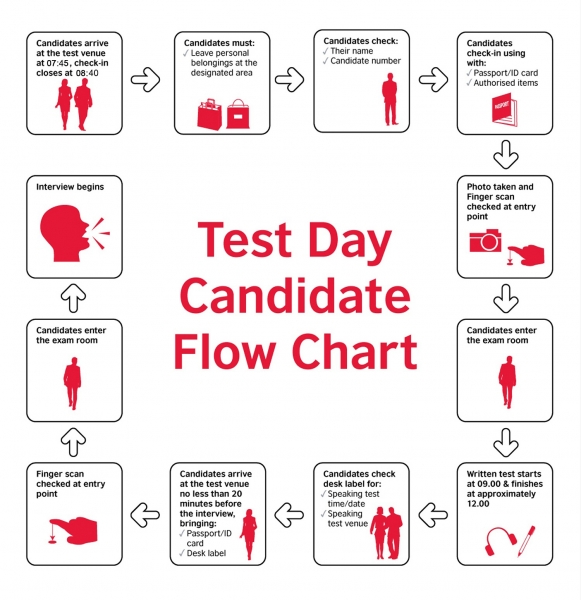
When you arrive at the test center, you will undergo a mandatory check-in process to verify your identity and prevent proxy test-taking. Expect the following biometric checks:
-
Identity Verification: An invigilator will cross-check your physical appearance with your passport photo.
-
Fingerprint Scanning: Your finger or thumbprint will be digitally scanned.
-
Test-Day Photograph: A high-resolution photograph of your face will be taken at the registration desk. Crucial Tip: This specific photograph will appear on your final IELTS Test Report Form (TRF), so dress neatly and appropriately!
5. Timeline and Arrival Rules
Punctuality is a non-negotiable IELTS requirement. Test centers operate on strict global schedules, and latecomers are strictly barred from entering.
-
Arrive Early: It is highly recommended to arrive at least 45 to 60 minutes before your scheduled start time. This gives you ample time for parking, navigating the building, utilizing the cloakroom, and completing biometric registration.
-
The Late Policy: If the registration doors close, you will not be allowed into the exam hall, and you will forfeit your entire registration fee.
6. The Speaking Test Day Requirements
The IELTS Speaking test may take place on the same day as your Listening, Reading, and Writing (LRW) components, or it could be scheduled up to 7 days before or after.
Regardless of the day, the requirements remain strict:
-
You must bring the exact same passport/ID used for the LRW components.
-
You will undergo identity and fingerprint verification again before entering the Speaking interview room.
-
Whether your interview is face-to-face with an examiner or via an official high-definition video call at the center, no phones, watches, or notes are permitted inside the room.
Checklist Summary for IELTS Test Day
To ensure you don’t forget anything critical, run through this quick checklist the night before your exam:
-
[ ] Original, Valid Passport (or registered ID document)
-
[ ] Confirmation Email/Letter (printed or accessible on your phone for check-in)
-
[ ] 2B Pencils, Pens, and Erasers (with labels removed, if taking paper-based)
-
[ ] Transparent water bottle (with label completely removed)
-
[ ] Comfortable clothing (examination rooms can sometimes be chilly due to air conditioning)
-
[ ] No watch, no phone, and no unauthorized jewelry worn into the hall
By strictly adhering to these official regulations, you can eliminate unnecessary test-day anxiety and focus 100% of your energy on achieving your target band score. Good luck!
Mastering Your IELTS Test Day: A Comprehensive Guide
The IELTS (International English Language Testing System) is a significant milestone for many students aiming to study, work, or migrate abroad. While your preparation leading up to the exam is crucial, knowing exactly what to expect on the day of the test can significantly reduce anxiety and help you perform at your best.
This guide provides a roadmap for your test day, ensuring you are prepared from arrival to the final minute of the exam.
- Before You Leave Home: The Essentials
Your success on test day starts before you even walk out the door. Being organized minimizes stress and ensures you have everything you need.
- Identification: The most important item is the original, valid identity document (passport or national ID) you used when registering for the test. You will not be allowed into the test room without it.
- Stationery: While test centers usually provide pencils and erasers for the listening, reading, and writing sections, it is good practice to bring your own if permitted. Check your specific test center’s guidelines.
- Arrival Time: Plan to arrive at least 45 to 60 minutes early. Late arrivals are generally not permitted to enter the exam room.
- Arrival and Registration
When you arrive at the test center, follow the instructions of the invigilators closely.
- Security Checks: Expect strict security protocols. You will likely be asked to leave personal belongings—such as mobile phones, smartwatches, bags, and electronic devices—in a designated secure area. Do not bring valuables to the test center if possible.
- Biometrics: Most centers now require biometric registration, which may include a fingerprint scan or a photograph, to verify your identity.
- Test Room Protocol: You will be guided to your desk. Ensure your ID is placed clearly on the desk throughout the test.
- During the Test
The IELTS test consists of four sections: Listening, Reading, Writing, and Speaking.
The Listening, Reading, and Writing Sections
These three sections are usually taken on the same day, one after another, without long breaks.
- Listening: You will hear a series of audio tracks. Listen carefully to the instructions and stay focused. Remember that you only hear the audio once.
- Reading: Manage your time wisely. You have 60 minutes to complete three reading passages and answer the questions. Do not get stuck on one difficult question; move on and come back later if time permits.
- Writing: Organize your essay and report/letter clearly. Pay close attention to word counts and ensure your structure is logical.
The Speaking Test
The Speaking test may be scheduled on the same day as the other sections or on a different day, depending on the test center.
- The Interview: This is a face-to-face interview with an examiner. Treat it like a professional conversation.
- Be Natural: Avoid memorized answers. The examiner wants to assess your ability to communicate naturally and fluently in English.
- Staying Calm and Focused
The environment can be intense, but your mindset is your greatest asset.
- Pacing: Keep an eye on the clock. Every section has a strict time limit.
- Instructional Clarity: Always read the instructions on your question paper twice. Misinterpreting a task is a common way to lose points unnecessarily.
- Positive Mindset: If you make a mistake, do not dwell on it. Focus immediately on the next question.
Next Steps in Your Journey
Preparing for the IELTS is just one step in your broader academic or career journey. For more comprehensive resources on pursuing your education abroad, navigating admissions, and finding the right path for your future, explore the resources available at Student Arrive.
Whether you are looking for tips on writing your statement of purpose or need guidance on securing scholarships, ensure you have the right information to make your study-abroad dreams a reality.
Good luck with your exam! Proper preparation is the bridge between your current efforts and your future success.
Be prepared
- Double-check the time and date of your test. If you are taking the test in a test centre, allow plenty of time to travel to the test centre. If you are taking IELTS Online, download the test day software (you will be emailed about this) in advance and give yourself extra time to log in. If you are late, you may not be allowed to take the test.
- Make sure you have the same identification document with you that you registered with. If you arrive with the wrong ID, you will not be allowed to take the test.
- IELTS Online test takers must check their computer meets our system requirements.
Relax
- Try to remain calm.
- If you start to feel worried, take some deep breaths to help you calm down.
- Work calmly, focus on the questions, and don’t rush your answers.
- Read the IELTS rules and regulations before the test so you understand them. You’ll find these in theIELTS application form.
- If you have any questions, our friendly test centre staff and online proctors are there to help.
Follow the instructions
- Switch off your mobile phone and any other electronic devices. You will be asked to place all of your personal belongings outside the test room. If taking IELTS Online you will need a phone or tablet with a camera to use during the room scan.
- The Listening, Reading and Writing tests take 2 hours 40 minutes and there are no breaks between each section of the test.
- Make sure you are prepared and have something to eat and drink beforehand. You will not be allowed to take food into the test room. You will only be allowed to take a drink in a transparent bottle.
- Listen to the supervisor or online proctor carefully and follow the test day instructions.
- Read the test instructions before writing your answers.
- Read the questions carefully. Not doing so may lead to mistakes and you may lose points.
Watch the time
- Watches are not allowed in the test room. Every test room in our test centres has a clock on the wall, and the IELTS Online test has a clock on the screen. Stay aware of the time so you can attempt all questions.
- The Listening, Reading and Writing tests have a number of sections. Allow enough time for each section.
- Be aware that some questions have suggested time limits for you to follow.
Need more information about your IELTS test day that isn’t covered above? Please contact your test centre or one of the IELTS Partners directly for further information.
RELATED POST