
GRE General vs. Subject Tests: Understanding the Differences
The GRE (Graduate Record Examination) is a widely recognized standardized test for admission to graduate and business schools worldwide. GRE offers two main types of tests: the GRE General Test and the GRE Subject Tests. Understanding the differences between these tests is essential for prospective graduate students to select the right exam based on their academic goals and program requirements.
This article provides an in-depth comparison of the GRE General and Subject Tests, including their formats, purposes, and tips for preparation.
What is the GRE General Test?
The GRE General Test evaluates your overall academic readiness for graduate school and focuses on three core areas:
- Verbal Reasoning: Measures reading comprehension, critical reasoning, and vocabulary skills.
- Quantitative Reasoning: Assesses basic math skills and problem-solving abilities.
- Analytical Writing: Tests your ability to articulate complex ideas clearly and effectively in writing.
The GRE General Test is required by most graduate programs and business schools. For a comprehensive overview of the GRE format and preparation tips, visit GRE Test Format and Tips.
What are the GRE Subject Tests?
GRE Subject Tests evaluate your knowledge and skills in specific academic disciplines. They are designed to assess your mastery of subjects relevant to your intended graduate program. Currently offered Subject Tests include:
- Biology
- Chemistry
- Literature in English
- Mathematics
- Physics
- Psychology
These tests are often required or recommended for admission to specialized graduate programs in these fields.
For guidance on choosing the right GRE test for your field, see How to Choose Graduate Admission Tests.
Key Differences Between GRE General and Subject Tests
| Aspect | GRE General Test | GRE Subject Tests |
|---|---|---|
| Purpose | Measures general academic skills | Assesses knowledge in a specific subject |
| Test Format | Verbal Reasoning, Quantitative Reasoning, Writing | Multiple-choice questions focused on subject matter |
| Duration | Approximately 3 hours | About 2 hours |
| Score Type | Composite score for verbal and quantitative sections | Subject-specific scaled score |
| Required by Programs | Most graduate and business schools | Select specialized programs |
Explore more on GRE test differences at GRE Exam Insights
When to Take the GRE General Test vs. Subject Tests
- GRE General Test: Recommended for applicants applying to a wide range of graduate programs and business schools. It evaluates your critical thinking and problem-solving skills regardless of your undergraduate major.
- GRE Subject Tests: Ideal for students applying to specialized programs that require in-depth knowledge of a particular subject. Some programs make these tests mandatory, while others view them as supplementary.
Learn how to decide which test to take at Graduate School Admission Requirements.
Preparation Tips for GRE General and Subject Tests
- For the General Test, focus on improving vocabulary, math fundamentals, and writing skills. Practice with official GRE sample questions and take timed practice tests.
- For Subject Tests, review core concepts, theories, and problem-solving techniques specific to the subject. Use textbooks, academic journals, and practice exams designed for the Subject Test.
For comprehensive preparation strategies, visit GRE Preparation Resources.
Registration and Test Day Information
Both GRE General and Subject Tests are administered by ETS and can be taken at authorized test centers worldwide. The General Test is available year-round, while Subject Tests are offered on specific dates.
Familiarize yourself with the registration process and test day procedures at GRE Registration and Test Day Guidelines.
Choosing between the GRE General and Subject Tests depends on your academic background, target graduate programs, and career goals. The General Test evaluates broad skills important for graduate study, while Subject Tests focus on specialized knowledge in particular fields.
Understanding these differences and preparing accordingly will enhance your chances of success. For further resources and expert guidance, explore the StudentArrive GRE Resources.
GRE General vs. Subject Tests
he GRE is a standardized test that evaluates Verbal Reasoning, Quantitative Reasoning, and Analytical Writing in graduate school applicants. It is accepted by thousands of graduate and business programs around the world. Some programs also require specific GRE subject tests. The seven subject tests are intended for students who have an undergraduate major or extensive background in these disciplinces: Biochemistry, Cell and Molecular Biology; Biology; Chemistry; Literature in English; Mathematics; Physics; and Psychology. The GRE Computer Science Test was discontinued in April 2013.
GRE Subject Tests provide a common measure for comparing student qualifications, and are intended to supplement undergraduate records, recommendations, and other qualifications for graduate-level study. Subscores indicate strengths and weaknesses in an individual student’s preparation and may also be useful for guidance and placement purposes. While the GRE General Test is used primarily as a criterion for admission to gradute programs, the GRE Subject Tests also enable graduate programs to begin customizing student curricula to build on their strengths and compensate for their weaknesses.
You may also like:
- IELTS Eligibility Criteria
- IELTS Exam Fees in India
- IELTS Exam
- IELTS Academic vs IELTS General
- IELTS vs TOEFL vs PTE – Advantages and Disadvantages, Pros
- Differences Between IELTS vs TOEFL vs PTE
- List of Entrance Exams to Study Abroad
- International Entrance Exams to Study Overseas
- Swedish Institute Scholarships for Global Professionals
- British Chevening Scholarships in UK for International Students
- Hubert Humphrey Fellowships in USA for International Students
- Fulbright Foreign Student Program in USA
- Joint Japan World Bank Graduate Scholarship Program
- ESED Scholarships for Sustainable Energy Development Studies
- OFID Scholarship Award for International Students
- Top 10 Scholarships for Study in Any Country or Anywhere
- Aga Khan Foundation International Scholarship Programme
- Human Frontier Science Program Postdoctoral Fellowships
- McDonald Fellowships (Fully Funded)
ETS, the administrator of the GRE General Test as well as the GRE Subject Tests, is continually revising its testing material to better reflect the needs of graduate programs and the modern economy. Thousands of researchers collaborate with universities around the country and with top scientists around the world to ensure that the content of each subject test will be useful both to the individuals who take it and to the institutions that accept it. Because the frontiers of education in graduate school are constantly changing, it is important to ensure that the tests are also making minor adjustments to help students prepare to make meaningful creative contributions in their chosen field of study.
Subject tests are offered at paper-delivered test centers worldwide three times per year, in September, October, and April. They are accepted by thousands of graduate schools and departments. Although scores may not be required for a particular program, admissions committees are likely to consider the scores if they are submitted.
The Biochemistry, Cell, and Molecular Biology test consists of 170 multiple choice questions in three sections: Biochemistry, Cell Biology, and Molecular Biology and Genetics. The Biology test consists of 190 multiple choice questions in three sections: Cellular and Molecular Biology, Organismal Biology, and Ecology and Evolution. The Chemistry test consists of 130 multiple-choice questions in four sections: Analytical, Inorganic, Organic, and Physical Chemistry. The Literature in English test consists of approximately 230 multiple-choice questions in four sections: Literary Analysis, Identification, Cultural and Historical Contexts, and History and Theory of Literary Criticism. The Mathematics test consists of 66 questions drawn from Calculus, Algebra, and additional topics. The Physics test consists of 100 questions covering Classical Mechanics, Electromagnetism, Atomic Physics, Optics and Wave Phenomena, Quantum Mechanics, Thermodynamics and Statistical Mechanics, Special Relativity, Laboratory Methods, and Specialized Topics. The Psychology test consists of 205 questions covering Experimental, Social, and General Psychology topics.
ETS Major Field Tests
ETS Major Field tests are designed to measure undergradate accomplishment in a major field of study. ETS has developed tests to cover the topics of Biology, Chemistry, Computer Science, Criminal Justice, Economics, Literature in English, Mathematics, Music, Physics, Political Science, Psychology, and Sociology. In addition, ETS also has tests for students who have earned an Associate’s, Bachelor’s, or Master’s degree in business. Institutions use the Major Field Tests to evaluate students mastry, to assess the effectiveness of different major programs, and to improve curricula and instruction methods. Students typically take their Major Field Tests in their final year of study after completing the majority of their required coursework.
In addition to measuring factual knowledge in a subject area, Major Field Tests also evaluate students’ ability to analyze and solve problems, understand relationships, and interpret material from their major field of study. ETS offers comprehensive national data for their tests, enabling institutions to evaluate student performance and compare the effectiveness of their programs to other similar institutions worldwide. While the GRE General Test and GRE Subject tests are intended to benefit students by helping them gain access to graduate education and networking, the ETS Major Field Tests are more useful to undergraduate institutions and business schools who are looking to assess their own students, compensate for any weaknesses in their instruction, and increase their international competitiveness in the education market.
Related Posts:
- Graduate Record Examination (GRE)
- GRE Scoring
- Computer Test vs. Paper Test
- GRE Administration
- GRE 2011 Changes
- GRE Basics – All about the GRE
- GRE Exam FAQs
- GRE General Test & Exams
- GRE General Test at Home Testing
- How to Register for the GRE General Test
- GRE Exam and Dates
- How to Choose IELTS Test Dates
- How to Send IELTS Scores to Colleges
- IELTS Preparatory Tips: Listening Section
- IELTS Preparatory Tips: Reading Section
- IELTS Preparatory Tips: Writing section
- IELTS Preparatory Tips: Speaking Section
- How to Improve your IELTS Listening Score
- Best 5 Books and Resources for IELTS
- Time to Start the IELTS Preparation
- IELTS Exam: Tips to Achieve a High Score
- Section Wise IELTS Exam Syllabus
- How to Prepare for IELTS at Home
- Top 10 IELTS Coaching Centers in India
- How to Calculate IELTS score
- UK – International Scholarships
- KU Leuven Scholarship| Application Process Fully Funded
- ARES Scholarships Belgium| Fully Funded
- Uk Scholarships for International Students 2026/2026
- Robert S. McNamara Fellowships Program
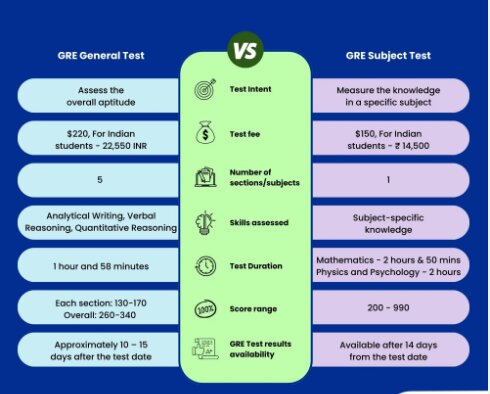
GRE General Test vs. GRE Subject Test: What You Need to Know
For students and professionals planning to advance their education, understanding the landscape of graduate entrance examinations is critical. The Graduate Record Examination (GRE) is a standard requirement for many programs, but it is divided into two distinct categories: the GRE General Test and the GRE Subject Test. Choosing the right one—or determining if you need both—depends heavily on your target program and academic goals.
For more insights on navigating your academic journey, you can explore additional resources on study abroad opportunities and admission guides.
The GRE General Test: Assessing Overall Aptitude
The GRE General Test is the most widely recognized exam for graduate admissions. It is designed to measure foundational academic skills that are considered necessary for success in a broad range of graduate programs, including business and law schools.
-
Core Focus: It evaluates your verbal reasoning, quantitative reasoning, and analytical writing skills. These sections assess your ability to analyze complex written material, solve quantitative problems, and articulate ideas effectively.
-
Format: The test is computer-delivered and is generally required by most Master’s (MA, MS) and PhD programs worldwide.
-
Flexibility: Because it assesses general aptitude rather than specialized knowledge, a strong score here provides maximum flexibility when applying to multiple schools or different disciplines.
The GRE Subject Test: Demonstrating Specialized Expertise
In contrast to the General Test, the GRE Subject Test is an achievement test that measures your depth of knowledge in a specific discipline. It is designed for candidates who have a strong undergraduate background in a particular field.
-
Core Focus: These tests assess your mastery of specific subject matter. Currently, Subject Tests are primarily offered in Mathematics, Physics, and Psychology.
-
Purpose: Admissions committees use these scores to supplement your undergraduate transcripts and recommendation letters. They serve as a specialized benchmark, particularly for highly competitive or research-intensive programs that want to verify your technical competency before admission.
-
Format: Unlike the General Test, these are focused on the curriculum of a specific major, typically covering topics usually studied at the undergraduate level.
Key Differences at a Glance
| Feature | GRE General Test | GRE Subject Test |
| Purpose | Measures general academic aptitude | Measures subject-specific knowledge |
| Focus Areas | Verbal, Quantitative, Writing | Mathematics, Physics, Psychology |
| Universality | Required by most graduate programs | Required/recommended by specialized departments |
| Format | Computer-delivered | Specialized subject-specific content |
How to Decide Which Test to Take
Deciding which exam(s) to sit for is a strategic part of your application process. Consider these factors:
-
Check Program Requirements: Always start by visiting the specific department’s admissions page. Some programs mandate the General Test, some strongly recommend the Subject Test, and others require both.
-
Highlight Your Strengths: If you have an excellent undergraduate record in a specialized field like Physics or Mathematics, a strong Subject Test score can serve as a powerful signal of your readiness for graduate-level research.
-
Application Flexibility: If you are applying to a wide variety of programs, prioritizing the GRE General Test is usually the safest route, as it satisfies the vast majority of institutional requirements.
As you prepare for these exams, remember that your test performance is only one component of your application. Admissions committees look at the “whole candidate,” including your personal statement and research background. You can find more tips on writing successful applications and managing your academic profile to ensure your entire application package stands out.
Disclaimer: Admission requirements can change annually. Always verify the current testing requirements directly on the official websites of the universities you intend to apply to.